
Best Car Dealership GPS Trackers (2026): Test Drives, Lots and BHPH Cars
-
01
Tell drivers and buyers about GPS in writing. Some states require it.
-
02
Update speed decides whether you catch a detour or read about it later
-
03
OBD trackers suit short-term use while hardwired fits financed vehicles
-
04
Tracking a car costs about $0.30 a day. One lost car costs far more.
-
05
Trip history provides evidence for disputes and recovery situations
As an Amazon Associate, Konnect GPS earns from qualifying purchases. Two of the trackers below come from sister brands, and we tell you where each tracker falls short.
You hand the keys to someone you just met. The car rolls off the lot, and you wait. The best car dealership GPS trackers turn that wait into a live map on your phone, so you can see the car while it is still out.
Test drives, loaners and buy here pay here (BHPH) cars all share one risk: once the car leaves, you are guessing. Will the driver bring it back on time? Will a quick errand turn into a joyride?
I'm Ryan Horban, and I've spent 15+ years working with GPS trackers on real vehicles. In this guide, I'll show you which tracker fits which job, what to put in writing for drivers, and what a whole lot costs to track. By the end, you'll know how to keep your cars safe and your test drivers honest, without the guesswork.

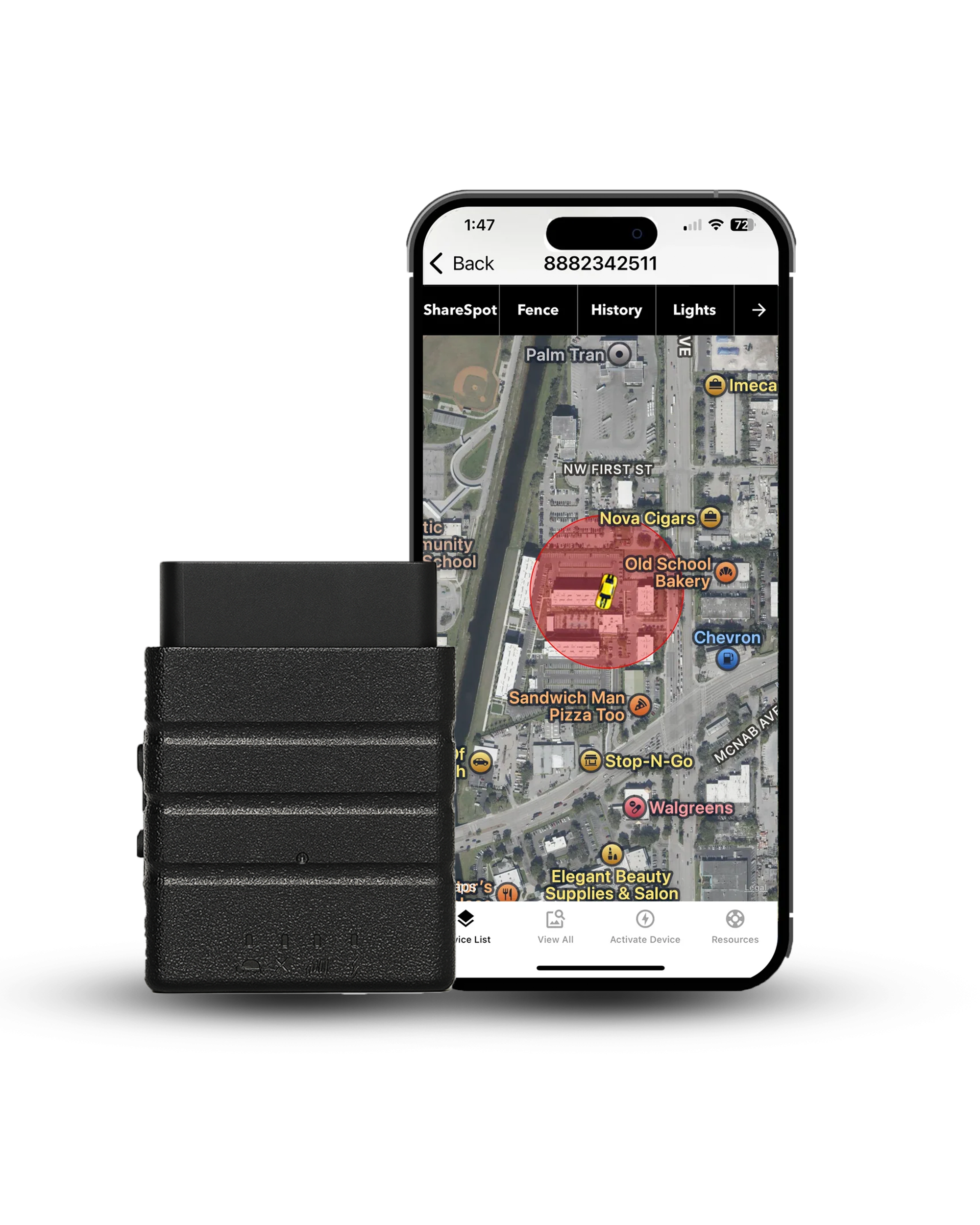
Konnect OBD2 GPS Tracker
Most trackers report once a minute. At highway speed that is over a mile of road between pings, which is useless when a test drive goes sideways. Konnect reports every 3 seconds and plugs into the OBD2 port in under a minute, with nothing to wire and nothing to charge.
$39.95 on sale, regularly $99.95
Which GPS tracker is best for a car dealership?
Konnect OBD2 is the best pick for test drives and lot cars. Install takes under a minute, and it reports every 3 seconds. For financed BHPH cars, a hardwired tracker with a kill switch fits better.
I'm Ryan Horban. After 15+ years with GPS trackers on real vehicles, I put Konnect GPS first for rotating inventory, because it moves between cars in seconds. For cars you finance, I point dealers to a hardwired unit, since a plug-in tracker can be seen and pulled.
What Is a GPS Tracker for Car Dealerships?
Dealership GPS trackers are small devices that show you where each car is, live, on your phone. You put one in or on the car, and the app does the rest.
You've got rows of cars sitting on your lot. Some for sale, some waiting on paperwork, a few out on test drives, and then there's that one you swear was parked near the fence yesterday. Know the feeling? With a tracker in each car, the guessing stops.
Trackers are built for car lot chaos. Konnect works for a handful of cars or for 100 or more. Fleet accounts show every car on one live map, and you can add or drop cars any time.

What is the OBD2 port?
The standard socket built into almost every car and light truck sold in the US since 1996, usually under the dashboard on the driver's side. Plug-in trackers get their power from the car, so there is nothing to charge and nothing to wire, and it moves between cars in seconds. Teslas and most motorcycles are the main exceptions.
There are three types most dealers use:
- OBD plug-in trackers: Pop right into the car's OBD port. Fast, easy, and perfect for cars that come and go quick.
- Hardwired trackers: Wired into the car's system. Super discreet, tough to mess with, and great for long-term lots or buy-here-pay-here cars.
- Magnetic portable trackers: Place it under the seat, bumper, or in the trunk. Ideal for temporary use, like a car someone's financing or a repo you might need to grab fast.
Each type fits a different job, so the next step is matching the tracker to the car.
OBD2 vs Hardwired vs Portable: Which Dealer GPS Tracker Fits?
The tracker you choose can protect your lot or leave you wide open. Pick the wrong one and you'll pay for it. Maybe it lags with slow updates. Maybe it needs a half-day install. Or worse, maybe a driver spots it and yanks it out like it's nothing. Money wasted, cars at risk, headaches you don't need.
So when you're choosing a dealership GPS tracker, here's what really counts:
- Update speed: Are you getting pings every 3 seconds, or every 60? Big difference when a car goes off-route.
- Ease of install: Can you plug it in and go, or do you need a technician with tools?
- Tamper resistance: How easy is it for someone to remove or disable the device?
- Best-fit use case: Is this for short test drives, long-term finance cars, or loaners that change hands daily?
Keep those four in mind. The table shows how each tracker type scores on them.
Dealership tracking device types, compared
| Feature | OBD2 GPS | Hardwired GPS | Portable magnetic |
|---|---|---|---|
| Install time | Plug and play in seconds | Wired in, a pro install may be needed | Place and go in under a minute |
| Best use case | Test drives, lot cars, rotating inventory | BHPH, financed cars, repossessions | Loaners, temp cars, discreet placement |
| Update speed | Every 3 seconds on Konnect, 15 to 60 on most others | As often as every 30 seconds | 3 seconds to a few minutes, by model and mode |
| Tamper resistance | Medium, visible in the OBD2 port, tamper alert on unplug | High, hidden wiring plus starter disable option | Low to medium, easy to remove if spotted |
| Cost to deploy | Low, no tools and no install costs | Higher upfront plus install fee | Medium, device plus magnetic mount |
Look closely at the OBD2 column. Plug-in trackers are fast and cheap, but a buyer can see them. On a test-drive car, that's fine. On a car you sold on payments, it can be a problem, so let's talk BHPH.
Related readingPortable, OBD or wired GPS tracker: the full comparisonGPS Tracker for Buy Here Pay Here (BHPH) Dealers
Buy here pay here means you sell the car and you hold the loan. If the buyer stops paying and the car goes missing, the loss lands on you.
The right tracker keeps that loss small.
What kind of GPS tracker do BHPH dealers need?
Most BHPH dealers pick a hardwired tracker with a kill switch for financed cars. The wiring hides under the dash, a buyer can't pull it in a minute, and the kill switch can stop the engine from starting. Konnect plugs into the OBD2 port, so a buyer can see it and unplug it. Konnect does send a tamper alert when that happens, but an alert is not the same as stopping it.
Four things matter most in a BHPH tracker:
- Kill switch: Stops the engine from starting, and you control it from your phone.
- Hidden wiring: A buyer shouldn't be able to find it and pull it in a minute.
- Unauthorized-use alerts: You hear about it when someone drives the car without permission.
- Backup battery: The tracker keeps reporting for a short time if the main power is cut.
The hardwired tracker in our list has all four. Konnect has a tamper alert and a backup battery that keeps it reporting for about 15 minutes after it is unplugged. That suits lot cars and test drives. For a car you finance, the hardwired route is the safer bet.
One caution: rules on kill switches and repossession differ by state. Ask your attorney before you use either one.
Need a kill switch for financed cars? The hardwired tracker in our list can stop the engine from starting, and you control it from your phone.
See the Hardwired TrackerWhere do dealers install trackers on BHPH cars?
Dealers usually pick one of three spots: the OBD2 port, under the dash, or a hidden magnetic spot. The OBD2 port is the fastest, but the tracker sits in plain view. Under the dash is the favorite for financed cars, because the wiring stays hidden, and a pro install may be needed. Magnetic trackers can go in a trunk panel, under a seat or on the frame. They work on cars with no usable OBD2 port, but their battery needs charging, so someone has to own that job.
Related readingBest hidden car GPS trackers: 6 picks for 2026What should you do when a BHPH payment is missed?
Keep it calm and keep it in order:
The Cost of Not Tracking Test Drives

Test-drive thefts are real, and nobody likes to talk about them. Once that car rolls off your lot without tracking, you are blind. No location, no alerts, no control. If the driver never plans to bring it back, you have already lost.
Car theft is down, and that is good news. The National Insurance Crime Bureau (NICB) reported 659,880 vehicles stolen in the US in 2025, a 23% drop from 2024. Even after that drop, the number works out to roughly 1,800 vehicles stolen across the country every day.
On a dealer lot, the risk looks different. Your car leaves with a stranger who holds your key and a signed form. Without GPS, you get a police report and a shrug. With GPS, you can see the car right now and hand the police a live location.
So you could skip tracking and hope. Or you could spend about $0.30 a day per car on a Konnect plan (see our GPS tracking device price list) and always know where it is. One lost test drive can cost you a whole car. The math is not close.
How Dealership GPS Tracking Protects Test-Drive Cars
A vehicle GPS tracker keeps your test-drive cars safe by doing one thing better than anything else: giving you live visibility. No delays. No guessing. Just real-time updates and instant alerts when something's off.

1. Real-time location updates
Every 3 seconds, the tracker reports the car's position. Most cheap trackers lag 15 to 60 seconds behind, and at highway speed a 60-second gap is most of a mile of road. Sixty seconds is not real time. Sixty seconds is a guess. Need to find a driver mid-route? You can. Want to catch someone going off-course? You will.
2. Alerts for speeding and leaving the zone
Knowing where the car is matters. Knowing when something goes wrong, without staring at the map, matters just as much. Konnect sends three kinds of alerts:
- Speeding alerts: Notified the moment they cross the threshold you set.
- Geofence breaches: Pinged the moment the car leaves your set zone.
- Tamper alerts: Told right away if the device is unplugged mid-drive.
You set the limits once. After that, the tracker watches the car for you.
Konnect keeps it simple: where the car is, how fast it goes, and when it leaves your zone. If you want driver scores, look elsewhere.
3. Geofences around your lot or route
Set invisible boundaries and stay in control. With geofencing you draw a digital fence around your dealership or an approved test-drive area, and if the car crosses that line the system alerts you instantly. You will know the moment someone decides to get creative with where they're going. New to geofences? Read how to use geofencing with an OBD GPS tracker.
4. Trip history for disputes or insurance
Ever had someone claim they just ran around the block? With trip history, you've got the receipts. The customer says one thing, the employee swears another, and without proof you're stuck guessing. Trip history shows exactly where the car went and how long it was gone. For insurance claims, disputes, or simple accountability, facts beat stories every time.
5. Live location to give the police
Car goes missing? Open the app and see where it is right now. Police find cars faster with a live position than with a last-known one.
On a dealership lot the only spec that decides anything is update speed. Once-a-minute reporting tells you where the car was, not where it is. On a stolen unit, that difference is the whole recovery.
Why Dealerships Use GPS Trackers Beyond Test Drives

1. Lot audits: skip the clipboards
Walking the lot. Scribbling VINs. Counting keys like it's 1995. With tracking, that grind disappears. Open the app, check the dashboard, and every car's location appears at once. Audits get faster, mistakes drop, and your staff isn't wasting hours hunting for cars that should've been sitting right where they belong.
2. BHPH loan protection: stop the vanishing act
Missed payments sting. Losing the car on top of it is a gut punch. When a payment stops, open the app and see where the car is that day, then step in before it disappears for good. Not sure which tracker fits financed cars? Jump to the BHPH section above.
3. Fleet and delivery monitoring: keep routes tight
If you run service techs or delivery drivers, side trips add up fast. Location history shows where each vehicle went and when, so you can spot detours and settle arguments with facts. Fleet accounts also put every car on one live map. Want the full list of options? See our guide to the best fleet GPS tracking device.
4. Employee accountability: cut the joyrides
We all want to believe our team always does the right thing, but temptation happens. Quick side trips. Personal errands. After-hours use when no one's watching. Tracking takes the guesswork out: you'll know when a car is being used off-hours, where it went, and how long it was gone. No awkward conversations, no relying on stories, just verifiable data. Company vehicle tracking isn't about mistrust, it's about protecting the business and making sure company time stays company time.
5. Keys: GPS finds the car, not the key
GPS trackers show you where the car is. They do not track the key. Key cabinets and key tags do that job, and many dealers run both. The key system tells you who has the key, and the tracker tells you where the car went.
Rotating inventory needs a tracker that moves between cars in seconds. Konnect unplugs from one vehicle and plugs into the next with nothing to rewire.
See the TrackerBest Car Dealership GPS Trackers: 5 Picks Compared
With so many choices out there, dealers don't just need a tracker, they need the right tracker. One that's fast, easy to use, and built for the daily realities of test drives, lot cars and BHPH vehicles.
Start with the quick view. The details on each tracker come right after the table.
| Tracker | Type | Updates | Kill switch | Plan per month | Best for |
|---|---|---|---|---|---|
| Konnect OBD2 | Plug-in (OBD2) | Every 3 seconds | No | $8.95 | Test drives and lot cars |
| SpaceHawk | Magnetic, battery | 3 seconds to 3 minutes | No | From $19.95 ($9.95 on a two-year prepay) | Loaners and cars with no OBD2 port |
| Hardwired with kill switch | Hardwired | Every 30 seconds | Yes | $14.95 | BHPH and financed cars |
| Tracki Pro | Portable, battery | 15 seconds to 1 minute, by plan | No | From $9.95 on long-term plans | Odd vehicles and equipment |
| Bouncie | Plug-in (OBD-II) | Not published | No | $9.65 | Small lots that also want engine data |
1. Konnect OBD2 GPS Tracker

Konnect is a real-time GPS tracker that plugs directly into the car's OBD2 port, the same port mechanics use to run diagnostics. No tools, no wires, no charging. The unit powers itself from the car, so there's zero battery maintenance, and it pairs with the Konnect app in seconds and starts reporting every 3 seconds. Of all the trackers I've tested, 3 seconds is one of the fastest refresh rates, against units running 15 to 60 second delays. Worried about cars that sit for weeks? Read our guide on whether an OBD GPS tracker drains your car battery.
Key features
- Installs in under a minute, just plug it in
- Updates every 3 seconds, roughly 20 times faster than a typical once-a-minute tracker
- Speed alerts, geofence alerts and a tamper alert if the unit is unplugged
- Backup battery keeps it reporting for about 15 minutes after it is unplugged
- One account and one live map for every car on your lot
- Rename each car in the app, so your team finds it fast
- Up to a year of trip and location history
- $8.95 a month with no contract
- US-based support plus a lifetime device warranty
Konnect: pros and cons for a dealership
- Moves between cars in seconds, which suits rotating inventory
- Updates every 3 seconds, as fast as any tracker in this list
- Nothing to charge, so a lot car is never dead on arrival
- Visible in the OBD2 port, so it can be spotted
- Shows location, speed and zones only, with no driving scores
- Needs a working OBD2 port, so pre-1996 stock is out
- Does not work on Teslas or most motorcycles
2. SpaceHawk GPS Tracker

SpaceHawk is a small magnetic tracker designed to sit on a vehicle discreetly. Glove box, wheel well, undercarriage: it holds itself in place with a strong magnet and blends in. No wires needed. The unit runs on a rechargeable battery and connects to a live tracking app on iPhone, Android or desktop, transmitting real-time location accurate to within about 6 feet, with route history, speed and customizable alerts such as movement at odd hours.
$39.95 on sale, regularly $89.95, plus a data plan.
Key features
- Real-time tracking with updates as fast as every 3 seconds
- Geofence and movement alerts, plus a police reporting mode
- Strong magnetic mount for placement anywhere on a vehicle
- Waterproof housing, so weather and road spray are not an issue
- Rechargeable battery with weeks of tracking per charge
- iOS and Android apps with live location, history and alerts
- US-based support and a lifetime warranty
- Month-to-month plan from $19.95, dropping to $9.95 on a two-year prepay
SpaceHawk: pros and cons for a dealership
- Works on any vehicle, including ones with no usable OBD2 port
- Nothing plugged into the dash for a customer to notice
- Moves between cars in seconds
- Runs on its own battery, so somebody has to keep it charged
- Stops reporting entirely once flat
- Can be removed if it is found
- No kill switch, so it shows the car but cannot stop it
3. Hardwired GPS Tracker With Kill Switch

This one wires into the car and connects to the starter relay. It reports location as often as every 30 seconds through its tracking platform. The design targets fleet managers, dealerships and auto finance companies, and the thing that sets it apart is remote starter disable: activate the kill switch and the engine won't start even with the keys in hand. You can re-enable it remotely, without tools. For overdue rentals, unauthorized use or an extra layer of theft protection, it gives you control rather than just visibility.
$249.95 on sale, regularly $299.95, plus a $14.95 monthly plan.
Key features
- Remote starter disable from your phone or dashboard
- Location updates as often as every 30 seconds
- Unauthorized use alerts
- Up to a year of trip history
- Permanent, stable install for long-term use
- Backup battery keeps it reporting if primary power is cut
- Hidden wiring makes it harder to find and disable
- One-year warranty and free tech support
Hardwired: pros and cons for a dealership
- The kill switch is the strongest recovery tool in this list
- Hidden wiring makes it the hardest to remove
- Never needs charging or re-installing
- Needs wiring, and a pro install may be needed
- Costs more to run than Konnect at $14.95 a month
- Slower reporting at 30 seconds
- Not practical for stock that turns over quickly
4. Tracki Pro GPS Tracker

The Tracki Pro is a heavy-duty portable tracker built around battery life and versatility. A 10,000mAh battery keeps it going for months, and it runs on 4G LTE with 3G and 2G fallback. Mount it with the included magnet, a mounting plate or 3M tape. No tools required.
$18.99 on sale, regularly $29.98, plus a subscription. Long-term plans start at $9.95 a month.
Key features
- Battery life of 2 to 12 months per charge depending on mode
- Coverage in 185+ countries
- Updates every 15 seconds to 1 minute, depending on plan
- Wi-Fi fallback indoors when GPS signals are weak
- Waterproof and rugged
- Magnet, screw or tape mounting
- Alerts for speed, geofence, movement, idle time, impact and low battery
Tracki Pro: pros and cons for a dealership
- Longest battery life of anything portable here
- Mounting options suit odd vehicles and equipment
- Holds signal where coverage is patchy
- Months of battery life come from slower update modes
- Still needs collecting and charging between vehicles
- Removable if a driver finds it
5. Bouncie OBD GPS Tracker

Bouncie is a small plug-and-play device that slides into the OBD-II port and syncs with the Bouncie app. The device ships with GPS, 4G LTE, a built-in SIM and sensors covering driving habits and engine health, so you get location, trip history and alerts on speeding, hard braking and idling. Handy for small fleets that want driver and engine data, and a reasonable choice if that data matters to you as much as position.
$89.99 for the device, plus $9.65 a month.
Key features
- Plug-in install on most 1996 and newer vehicles
- Live location with unlimited trip history
- Built-in SIM with 4G LTE
- Tracks speeding, braking, idle time and trip logs
- Watches engine health and sends maintenance alerts
- Geofencing, accident detection and weather alerts
- $89.99 device plus $9.65 a month with no contract, with a lower per-device rate at three or more
Bouncie: pros and cons for a dealership
- Engine diagnostics and behavior data alongside location
- Volume pricing helps across a larger lot
- Unlimited trip history included
- Publishes no update rate, while Konnect states 3 seconds
- Covers the US, Canada and Mexico only
- Higher upfront cost than Konnect at $89.99
How Much Does a Dealership GPS Tracker Cost for a Whole Lot?
Plug-in trackers like Konnect cost $8.95 per car per month on the plan, plus a one-time device price. Hardwired trackers with a kill switch cost $14.95 per car per month, plus a higher device price and an install.
Multiply that by the size of your lot, and the plan bill looks like this:
| Cars on your lot | Konnect plan per month | Konnect plan per year | Hardwired plan per month | Hardwired plan per year |
|---|---|---|---|---|
| 10 cars | $89.50 | $1,074.00 | $149.50 | $1,794.00 |
| 25 cars | $223.75 | $2,685.00 | $373.75 | $4,485.00 |
| 50 cars | $447.50 | $5,370.00 | $747.50 | $8,970.00 |
| 100 cars | $895.00 | $10,740.00 | $1,495.00 | $17,940.00 |
Devices cost extra, one time. The Konnect plug-in lists under $100 even at full price. The hardwired tracker is $249.95 on sale, plus the install. That gap is one reason to match the tracker to the car: plug-ins for lot cars, hardwired for financed ones.
Think of a 25-car lot. On Konnect, the plans come to $223.75 a month, or about $0.30 a day for each car. Compare that with the price of the cheapest car on your lot.
Plan prices checked in October 2026. Prices and sale offers can change, so confirm them on each product page.
Tracking 5 or more cars? Ask for a volume quote. You get a reply from a real person within one business day.
Get a Volume QuoteWho Needs a Dealer GPS Tracker?

GPS tracking is not just for big-name auto groups or franchise chains. If you're handing over car keys even once, this is for you.
- New car dealers: Demo cars go out for test drives every day. You need to know they're not being thrashed or taken off-route.
- Used car dealers: Your margins are tighter and your risks are higher. One missed payment and you need to find that car fast.
- BHPH dealers: You're not just selling the car, you're the bank. And banks track their assets.
- Rental or loaner operations: Cars come and go all day. Who's driving what, for how long, and are they where they said they'd be? Our guide to the best OBD GPS tracker for rental cars answers all three.
- Delivery and service fleets: You're losing money on detours and side errands. Track it, prove it, fix it.
If you hand over keys or send cars out on the road, you are on this list.
The Test-Drive Security Playbook
Let's walk through how tracking actually protects your vehicles during a test drive. No tech jargon, no confusing setup, just a process that works whether you're running a used car lot or a multi-location dealership.

Is GPS Tracking Legal for Car Dealerships?
Yes, dealers can track cars they own. Telling people in writing is still the smart move, and some states require notice. Skip it and you open the door to lawsuits, fines and a mountain of trouble.
Dealer GPS consent quick guide
| Use case | Tell them in writing? | What to do |
|---|---|---|
| Test drive | Yes, best practice | Add a short GPS line to the test drive form. |
| Loaner vehicle | Yes, best practice | Put GPS terms in the loaner agreement. |
| BHPH financing | Yes, check your state | Put it in the finance contract. |
| Employee vehicle | Yes, required in some states | Put it in the handbook and the employee policy. |
Tracking someone without telling them is a privacy problem, and it can cost you more than bad press. Disclose it, write it down, and keep a signed copy. Ask your attorney to write the wording once, then reuse it on every form.
Get the consent in writing before the keys leave the desk
Everything on this page assumes vehicles the dealership owns or finances. Placing a tracking device on a car belonging to someone else, including a customer's trade-in or an employee's personal vehicle, is a crime in several states, including California under Penal Code 637.7 and Texas under Penal Code 16.06. The exemptions in those statutes cover the registered owner or lessee, which is you on your own stock and is not you on a car you have not bought yet.
Employee vehicles carry their own rules. New Jersey requires written notice before an employer uses a tracking device in a vehicle used by an employee, and that covers company-owned and employee-owned vehicles alike. Connecticut, Delaware and New York have electronic-monitoring notice statutes that employment attorneys generally advise treating as covering vehicle tracking too.
None of this is legal advice. Rules differ by state and change, so have an attorney review your test drive form, loaner agreement, finance contract and employee policy before you roll a tracking program out.
Pick the Right Dealership GPS Tracker and Stop Guessing
Most dealers don't lose cars because they picked the wrong tracker. They lose them because they picked none.
Match the tracker to the job. Plug a Konnect into test-drive and lot cars, and see every car on one live map. For cars you finance, add a hardwired tracker with a kill switch. Plan prices stay under a dollar a day for each car.
Neither choice is perfect. Konnect can be seen in the port. The hardwired unit costs more and needs an install. Pick the flaw you can live with for each job.
Start small. Put trackers on your next five test-drive cars and watch the first week. The map will teach you more than any guide, and you can add more cars once it proves itself.
After 15+ years with GPS trackers, I trust one rule: if you can't see the car, you can't protect it.
Know where every car is today.
Stop rolling the dice with your lot
You wouldn't leave the cash drawer open overnight, so why let test drives and financed cars roam with no oversight? Konnect gives you every car, every trip, every time, with 3-second updates instead of the once-a-minute most trackers manage. On sale now at $39.95, down from $99.95.
Get Started With KonnectAbout the Author

 Buy on Amazon