
What Is an OBD GPS Tracker? A Simple Guide for Drivers
-
01
Gas cars and light trucks sold in the U.S. since 1996 have an OBD2 port
-
02
Plug one in and watch your car move on a live map
-
03
The car powers the tracker, so there is nothing to charge
-
04
OBD trackers sit in plain view and can be unplugged, so know the limits first
-
05
Track only cars you own or have clear permission to track
Affiliate disclosure: This article contains Amazon affiliate links. As an Amazon Associate, GPS Tracker Shop LLC earns from qualifying purchases at no extra cost to you.
Hey, what is an OBD GPS tracker, and does your car really need one?
Most people only ask after something goes wrong: a teen misses curfew, a parent is late and not picking up, or the car is just gone from the driveway.
I'm Ryan Horban, and after 15 years in GPS tracking, I've helped parents, families of senior drivers, and business owners pick trackers that work in real life.
Knowing where the car is, right now, changes how those moments feel. Worry turns into a quick glance at your phone.
In this guide, you'll learn what an OBD GPS tracker does, how it works, where the port hides, what it can't do, and whether it's legal. No tech skills needed. You'll get plain words and the honest limits too. If you can plug in a phone charger, you can set one up.
What Is an OBD GPS Tracker?
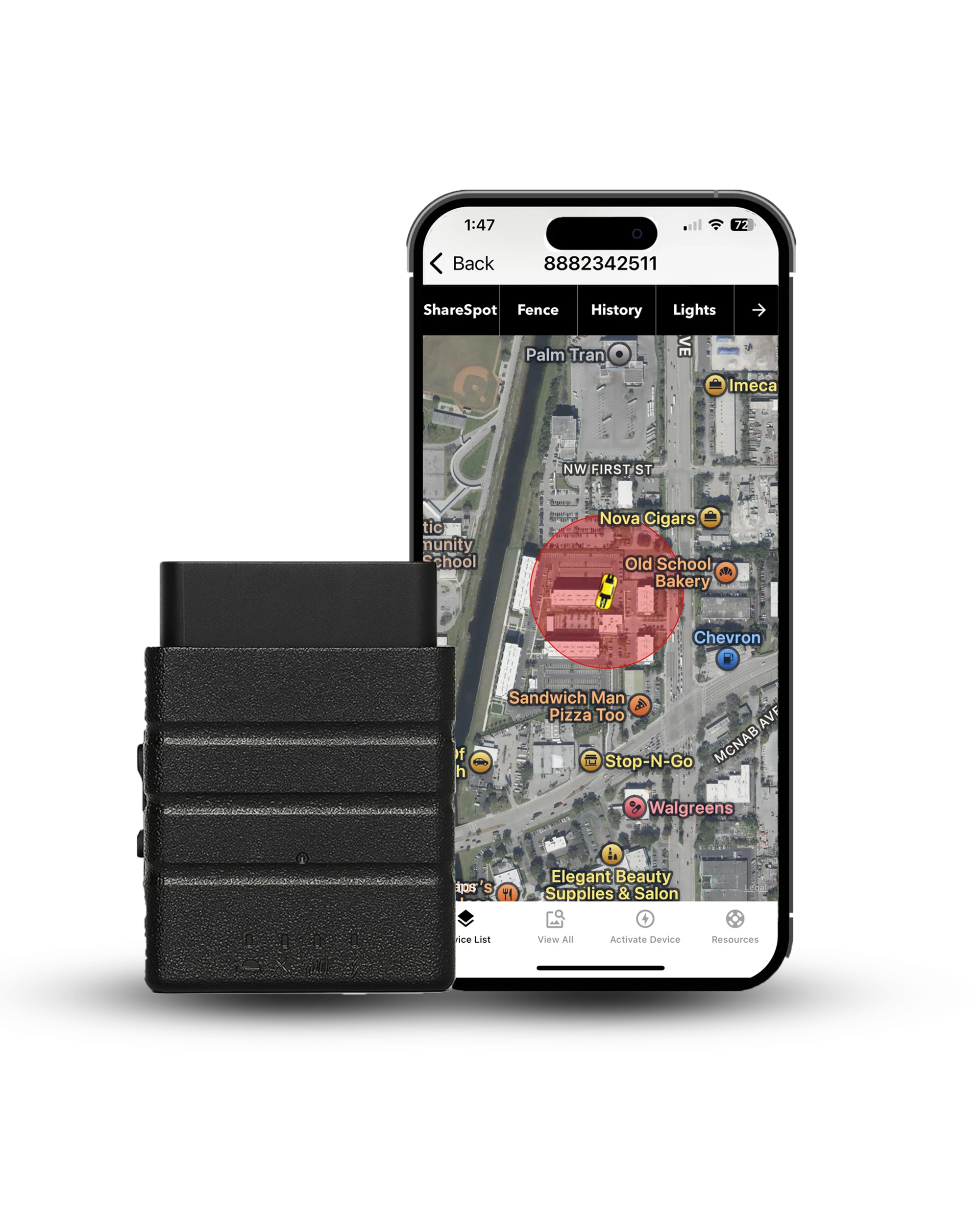
Put simply, an OBD GPS tracker is a small plug-in device that sits in your car's OBD2 port, takes its power from the car, and sends the car's live location to an app on your phone. There are no wires to connect and nothing to charge. Konnect GPS makes one that updates every 3 seconds.
What Does an OBD GPS Tracker Look Like?
Most look like a small plastic box with a plug on one end. The plug has 16 pins and fits the OBD2 port one way only, so you can't force it in wrong. Many have a tiny light that blinks when power comes on.

What Does OBD Mean, and Is OBD2 the Same Thing?
OBD stands for On-Board Diagnostics, and OBD2 is the newer version that every modern car uses.
Mechanics plug into the port to read what's going on inside the engine. Many trackers just borrow its power. Konnect skips engine data and sticks to location.
Car brands also use slightly different computer languages behind that plug, called protocols. Good trackers handle the common ones for you, so you don't have to think about it.
How Does an OBD GPS Tracker Work?
Four things happen, one after another: the port powers the tracker, GPS finds the car, a cell network carries the location to the cloud, and the app shows it on your phone.
Think of it as a phone with no screen. Power comes from the car, the spot comes from satellites, and a cell signal carries that spot to the cloud.

How It Works, Step by Step
- Plug the tracker into the OBD2 port under the dash.
- The car powers it on. No buttons, no charging.
- GPS picks the car's spot, and the cell network sends it to the cloud.
- You open the app or web dashboard and see the car live.
Four steps, and only the first one needs your hands.
What Is OBD Tracking?
OBD tracking just means following a car with a GPS device that sits in its OBD2 port. Same idea, different name. You'll also see it called OBD2 tracking or an OBD vehicle tracker.
Konnect's tracker is accurate to about 3 meters (10 feet) with a clear view of the sky. Tall buildings, garages, and tunnels can blur that, and every GPS device has the same limit. Parked cars are no problem. Konnect draws under 30 milliamps when parked and keeps reporting with the car off.
In my experience, the number one reason a tracker "doesn't work" is simple: it wasn't pushed all the way into the port.
Want the deeper version? Read how an OBD GPS tracker gets power and sends your car's location, step by step.
Where Is the OBD Port in My Car?
Look under the dashboard on the driver's side, usually near the steering column or above the pedals.
Nobody shows you this port when you buy a car, so most drivers have never seen theirs. Some cars tuck it behind a small flip-down cover. Others put it closer to the center console.

The California Air Resources Board (CARB) says all 1996 and newer gasoline and alternate-fuel passenger cars and trucks must have an OBD II system, and 1997 and newer diesels too. You can read the rule in the CARB OBD II fact sheet.
Can't spot yours? Our OBD2 port location guide shows where it hides in different vehicles.
Why Drivers Plug In an OBD GPS Tracker
You park at the mall, shop for an hour, and walk out to an empty spot. Moments like this are why people buy these.

Here are the six things people use theirs for most:
How Common Is Car Theft Right Now?
NICB's latest release counts 659,880 vehicle thefts in 2025, which is 190,828 fewer than in 2024. Good news.
Still, that works out to about 1,800 cars a day. Live location gives police something solid to work with.
Who Gets the Most From an OBD GPS Tracker?
Who is this really for? Four kinds of drivers come up again and again.

If you're a parent, the goal isn't spying. Knowing your teen got there safely, without texting every hour, is the real point.
Caring for an aging parent? Trackers are a quiet way to keep an eye out while they keep their independence.
What an OBD GPS Tracker Can't Do
No tracker is perfect, and OBD trackers have a few weak spots worth knowing before you buy:
- Easy to spot: the plug sits in plain view under the dash, so anyone who knows cars can find it.
- Easy to unplug: pulling it out takes seconds. Konnect sends a tamper alert the moment it's unplugged and keeps reporting for about 15 minutes on a small backup battery.
- Needs the OBD2 port: cars older than 1996 and most motorcycles are out, and Tesla is not supported. Big semi trucks often use a different, round port.
- Focused on location: some trackers also read engine codes or score driving habits. Konnect doesn't, and sticks to location, speed alerts, geofences, and tamper alerts.
- Needs cell coverage: in a dead zone, updates can wait until the signal comes back.
None of these should stop you. They're just good to know up front.
OBD trackers sound like the obvious pick for every car: plug in, done. The catch is that a thief who knows cars may pull it out first. If your car is a high-theft target, my advice is to add a hidden or hardwired tracker too.
Will an OBD GPS Tracker Work in My Car?
Most cars work. Gas cars and light trucks from 1996 on are the easy yes, and most hybrids work too. The quick breakdown looks like this:
- Gas cars and light trucks (1996 and newer): yes, they have the port.
- Diesel cars and trucks: usually yes, though compatibility typically starts with 2004 and newer models.
- Hybrids: most work if the car has a standard OBD II port.
- Electric vehicles: it depends on the model, so check first.
- Tesla: not supported.
- Motorcycles, ATVs, and heavy trucks: these need different gear. Heavy trucks often use a round J1939 port instead.
Not sure about yours? Check the full list in our guide to which cars are compatible with OBD2 GPS trackers.
OBD2 GPS Tracker vs. Hardwired Tracker: What's the Difference?
OBD trackers plug in and take seconds to set up. Hardwired trackers connect to the car's wiring and hide behind panels, so they take longer to install but are harder to find.

| Feature | OBD GPS Tracker | Hardwired Tracker |
|---|---|---|
| Install time | Under 30 seconds to plug in | 30 to 60 minutes |
| Moving to another car | Easy, just unplug it | Hard, it's fixed in place |
| Hard to find | Low, it's visible under the dash | High, hidden behind panels |
| Needs the OBD2 port | Yes | No |
| Do it yourself | Yes, no tools | Often needs basic wiring skills |
| Best for | Family cars, teens, small fleets, short-term tracking | Long-term tracking, heavy equipment, or drivers who may tamper |
My take: if you want it working tonight, go with OBD. If the person driving might try to remove it, go hardwired.
How to Install and Set Up an OBD GPS Tracker
Skip the toolbox. This one takes about two minutes and your phone.

- Find the port: look under the dash on the driver's side. If you can't see it, check for a small cover.
- Plug in the tracker: push it in firmly until it seats. The car powers it on, so there is nothing to turn on or charge.
- Download the app: get the tracker's app for iPhone or Android, or use the web dashboard.
- Pair and sign in: follow the on-screen steps to link the tracker to your account.
- Check the map: start the car and look for the dot. If it hasn't moved after a few minutes, take a short drive so GPS can lock on.
Plugging in takes under 30 seconds. Setup with the app takes about 2 minutes. No tools, no mechanic.
And that covers the whole job: you can now track a vehicle through its OBD2 port, right from your driveway.
What to Look for When You Buy an OBD GPS Tracker
Not sure which one to pick? Start with these four checks:
- 4G LTE or newer: older 2G and 3G networks are being shut down in the U.S., so those trackers can stop working without warning.
- Update speed: some trackers refresh once a minute or slower. Konnect updates every 3 seconds, which matters when a car is moving.
- Total cost: add the device price and the monthly plan, and ask about contracts.
- Tamper alert, warranty, and returns: these tell you how much the company trusts its own product.
I always check the network type first. On a dead network, a tracker is just a plastic box.
Want to compare real products side by side? Read our guide to the best OBD GPS trackers in the USA.
OBD GPS Tracker With No Monthly Fee: What It Really Means
"No monthly fee" sounds great. Read the fine print first, because somebody still pays for the cell data.

What Does "No Monthly Fee" Really Mean?
Usually, the first year of service is prepaid, and a monthly plan starts after that. Always ask what happens in year two.
Konnect's two options work like this:
| Option | You pay today | Monthly bill in year one | After year one |
|---|---|---|---|
| Pay as you go | $39.95 for the tracker | $8.95 | $8.95 a month |
| Prepaid first year | $199 once | $0 | $8.95 a month |
Run the math on pay as you go: $39.95 plus 12 months at $8.95 comes to $147.35 for the first year, or about $12.28 a month. Prepaid costs more up front, and what you're buying is a year with no monthly bill. Some people simply like it that way. There's no contract on either one.
Pros of the prepaid year
- No monthly bill for 12 months
- One payment, easy to budget
- No contract to sign
Cons of the prepaid year
- Costs more up front
- The $8.95 monthly plan starts after year one
You can see the details on Konnect's prepaid first-year option.
Are OBD GPS Trackers Legal in the USA?
Yes. Using an OBD GPS tracker is legal in the U.S. on a vehicle you own, or when you have clear permission from the owner.
Parents, business owners, and fleet managers use them every day on cars they own or are responsible for. Trouble starts when someone tracks a car they don't own, in secret.
What the Law Says
Rules differ by state. Many states have laws against secretly tracking someone else's car, and stalking and privacy laws can apply too. The line usually falls like this:
- Your own car: you can track it.
- Your teen's car, when it's registered to you: you can track it, and telling your teen up front is smart.
- Employee vehicles owned by your business: usually fine, but check your state's rules on telling workers.
- Your partner's or a stranger's car: don't. Doing it in secret can break the law.
General information only, not legal advice.
Quick Legal Tip: Laws vary by state, especially for employees and shared vehicles. Check our 50-state guide to GPS tracking laws in the USA before you track anyone else's driving.
Final Thoughts: Should You Get an OBD GPS Tracker?
Most people buy a tracker the day after a scare. The smarter move is the day before.
Plugging in an OBD GPS tracker is the fastest way to get there. The tracker goes in under 30 seconds, needs no charging, and puts your car on a live map. Konnect adds tamper alerts, speed alerts, geofences, and a year of trip history, with a lifetime warranty and 30 days to change your mind.
After 15 years in GPS tracking, I still say the same thing: the best tracker is the one that's actually plugged in and working.
Plug it in tonight, and stop wondering.
Ready to Track Your Car in Minutes?
Plug it in tonight and see your car live every 3 seconds. $39.95 for the tracker, $8.95 a month, no contract, and 30 days to change your mind.
Shop OBD2 Tracker →About the Author

 Buy on Amazon