
Is an OBD GPS Tracker Worth It? Honest 2026 Guide
-
01
Update speed determines how useful real-time tracking is in critical situations
-
02
OBD trackers provide location, driving behavior, and vehicle diagnostics
-
03
Parents, fleets, theft recovery, and elderly care benefit most from tracking
-
04
Long-term subscription costs often exceed the upfront device price
-
05
OBD trackers are visible and limited to vehicles with compatible ports
Is an OBD GPS Tracker Worth It? Here's My Honest Answer After 15 Years
Affiliate disclosure: This article contains Amazon affiliate links. As an Amazon Associate, GPS Tracker Shop LLC earns from qualifying purchases at no extra cost to you.
Hey, glad you found this.
Let me save you some time right away: Yes, an OBD GPS tracker is worth it. But only if you buy the right one, and that's exactly what I'm here to help with.
I've seen people buy the wrong tracker, get frustrated with 60-second location delays, and write the whole category off. That's a shame, because the right device is a different experience entirely.
I'm Ryan Horban. I've been testing GPS tracking devices for over 15 years, hardwired GPS units, plug-and-play devices, magnetic trackers, and asset trackers. Last month, I plugged 9 different OBD GPS trackers into real vehicles and ran them through city driving, highway routes, and overnight parking tests in Dallas. I tracked location accuracy, real-time data refresh speeds, tamper alerts, app usability, and monthly subscription costs on every single one.
In this guide, I'll cover what OBD GPS trackers actually monitor, who gets the most use out of them, where they fall short, and which one came out on top after all that testing. By the end, you'll know exactly whether this is worth your money, and which one to buy if it is.
Let's get into it.
Quick Verdict: Worth It or Not?
Here's the fast version for anyone who wants a direct answer before reading further:
| Your Situation | Is an OBD Tracker Worth It? |
|---|---|
| Parent monitoring a teen driver | Yes, driver behavior monitoring is useful day to day |
| Small business with fleet vehicles | Yes, ROI from cutting fuel costs comes fast |
| An individual who wants theft recovery | Yes, live trail the moment your car moves |
| Need hidden or covert location tracking | No, look at a hardwired GPS or magnetic unit instead |
| Driving a pre-1996 vehicle | No, the OBD port is only standard from 1996 onward |
Now let's break all of this down properly.
What Is an OBD GPS Tracker and How Does the GPS Technology Work?

An OBD GPS tracker is a small plug-and-play device that connects to your car's OBD port, the onboard diagnostics port built into every US vehicle made after 1996. You'll find it under the dashboard near the steering column. Mechanics use it to pull diagnostic trouble codes when the check engine light comes on. An OBD tracker uses that same port for power and vehicle data.
Once plugged in, the GPS device locks onto satellite signals and uses a 4G cellular network to send your vehicle's location to an app on your phone. No wiring, no tools, no installer. Setup takes under a minute, and that's the whole appeal of plug-and-play devices.
Here's how the full chain works:
- Step 1: The tracker draws power from the OBD port, no battery needed
- Step 2: GPS locks onto satellite signals to pinpoint the vehicle's exact location
- Step 3: The cellular network transmits real-time data to your phone app every few seconds
- Step 4: You see the vehicle on a live map with street-level accuracy, updated constantly
When I ran the Konnect OBD GPS Tracker through city routes in Dallas, it locked onto exact driveways within seconds of the engine turning on. Location updates came through every 3 seconds, the fastest refresh rate of any OBD device I put on a vehicle. Nothing else I ran came close.
In detail: What Is an OBD GPS Tracker: Working, Setup, Features & Use
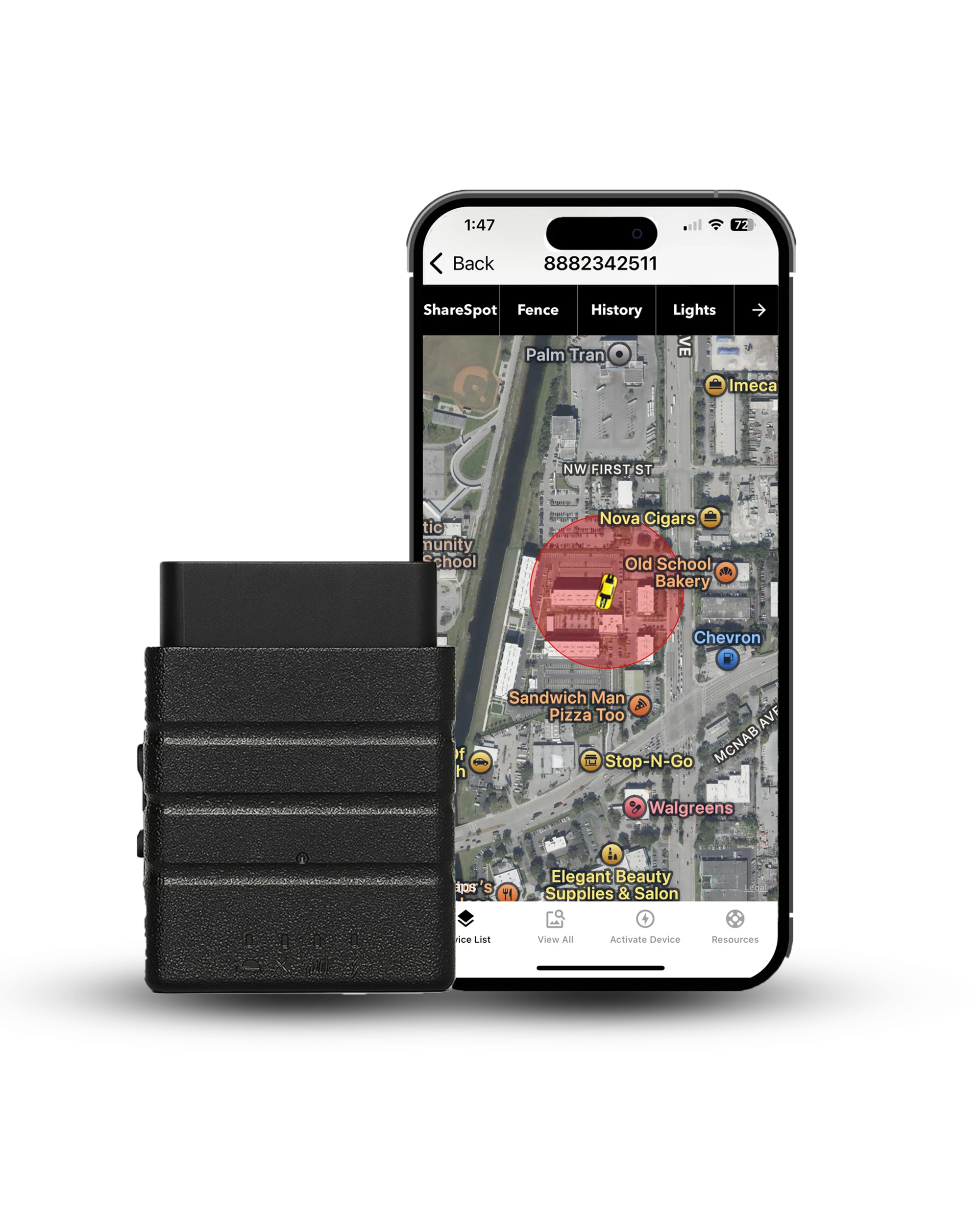
Konnect OBD2 GPS Tracker
World's fastest 3-second real-time car GPS tracker
- Updates every 3 seconds: 20x faster than most trackers
- Plug & Play: Simply plug it into your vehicle's OBD2 port and you're done.
- Worldwide Tracking: Monitor vehicles in over 150 countries with dependable, real-time GPS updates.
What Does an OBD GPS Tracker Actually Monitor?

A lot of people assume it's just a dot on a map. There's more to it. Here's what these devices track when connected through the OBD2 port:
Real-Time Location Tracking
Open the app, and you'll see exactly where your vehicle is on a specific street, in a specific parking spot. Most OBD trackers update every 30 to 60 seconds, which sounds fine until you're watching a vehicle move through city traffic and the map is a full block behind reality. At 3-second updates, you're watching actual movement as it happens.
If you want to know how real-time works: How Real-Time GPS Tracking Works: 3-Second Updates, Latency & Accuracy Explained
Trip History
Every route gets logged automatically. Trip history shows where the car went, which roads it used, how long it stopped, and when it came back. For fleet owners, that means a full paper trail on every driver. For parents, it means knowing whether your teen went straight to school or made a stop on the way.
Konnect stores up to one full year of trip history, enough for business records, insurance disputes, or just keeping tabs without constant check-ins.
Driver Behavior Monitoring
This one gets skipped over more than it should, and it's also where trackers differ the most from each other. Depending on the device, driver behavior monitoring can include harsh braking, rapid acceleration, hard cornering, idling time, and excessive speeds. Konnect's behavior monitoring is built around speed alerts and geofence activity: you set a speed threshold and geofence boundaries, and get notified the moment either one is crossed. Harsh braking, hard cornering, and idling aren't part of what it flags, so if those exact metrics are a dealbreaker for your fleet, check the spec sheet on any tracker you're considering before buying.
These behavior metrics matter beyond a phone notification. They feed directly into fuel efficiency, tire wear, and long-term maintenance costs. This guide explains exactly how OBD GPS trackers reduce fuel costs for fleets using real driving behavior data.
In fleet management, this is often the fastest lever for cutting costs. Drivers who know their behavior is being logged tend to accelerate less aggressively and stay closer to speed limits. That change shows up in fuel bills and maintenance costs within a few months.
See how to set up speed and geofence alerts on your Konnect tracker
Vehicle Health and Engine Diagnostics
Most OBD GPS trackers can read your vehicle's onboard diagnostics data. When the car's computer picks up a problem, the tracker can surface that diagnostic trouble code before the check engine light even comes on. For fleet vehicles, catching engine issues early is the difference between a $200 fix and a $2,000 breakdown on the side of the road.
This is what preventive maintenance looks like in practice, using real vehicle diagnostic data to deal with problems before they turn expensive. A business running five work trucks and ignoring engine health data is spending money it doesn't need to.
Geofence and Speed Alerts
You draw a virtual boundary on the map, a neighborhood, a job site, or a city limit. The moment the vehicle crosses it, your phone gets a notification. Same with speed: set a threshold, and you'll hear about it if someone is pushing the car too hard. In our Dallas runs, both alert types fired within seconds. No delays, no missed events.
If you want to know how to use geofencing: How to Use Geofencing with an OBD GPS Tracker | Easy Guide
Sleep Mode and Battery Management
A well-built OBD tracker drops into sleep mode when the vehicle has been parked for a while. This cuts power draw when the engine is off and protects the car's battery during long park times. For fleet vehicles sitting unused over a weekend, that's a practical consideration; a dead battery Monday morning is a slow, costly start to the week.
Who Actually Gets the Most Out of an OBD GPS Tracker?
Not every driver needs one of these. But for the following groups, the value is hard to argue with.

1. Parents of Teen Drivers
Teens are the highest-risk group on the road. According to the CDC, motor vehicle crashes are the leading cause of death for US teenagers. An OBD tracker gives parents visibility into not just where their teen is, but how fast they're driving. Speeding after 11 pm, a trip outside a geofenced zone, you'll know about it the moment it happens.
Most parents I've spoken with over the years say their teen became a noticeably better driver once they knew the data was being recorded. Not out of fear, because the teen could see it in the app too, and it became a shared reference point rather than a punishment.
Get the GPS tracker for teenager: GPS Tracker For Teenager
2. Small Business Owners and Fleet Managers
Fleet vehicles are expensive assets. Without location tracking, you're running on trust. Fuel costs go unchecked, side trips get quietly charged to the company, and there's no way to verify the hours logged.
One verified Amazon customer, Antonio G., switched from a competing tracker and noted the location updates were significantly faster, with an immediate impact on how the business ran day to day. For businesses managing 2–3 vehicles, the monthly subscription fee tends to cover itself within the first few weeks through fuel savings and route efficiency alone.
Check out the best GPS tracker for fleet management: Best Fleet GPS Tracking Device in 2026 (Tested & Ranked)
3. Car Owners Who've Thought About Theft
Over one million vehicles are stolen annually in the US, according to Konnect GPS's February 2026 Amazon launch announcement. An OBD tracker won't stop a determined thief. But the moment your car moves without your permission, you'll have a live trail to hand to law enforcement. That's the gap between theft recovery and a total loss.
The tamper alert is worth keeping in mind. The second someone unplugs the device, a notification goes straight to your phone. You'll know something is off before you've even stepped outside.
Prevent your car today from theft: How to Prevent Car Theft with OBD GPS Tracker (2026 Tips)
4. Families Keeping an Eye on an Elderly Parent
As drivers age, families often want some visibility without making it feel like surveillance. An OBD tracker lets family members check on a parent's vehicle without daily phone calls. Set geofence alerts around familiar routes, and you have a low-key way to stay informed if something unexpected happens, without hovering.
If you want to monitor your elderly parent's driving, click the link to learn how: Top 5 Ways To Stop Elderly Parents From Driving
OBD GPS Tracker Comparison: How the Top Options Stack Up
I've put Bouncie, Vyncs, MotoSafety, and BrickHouse Security's OBD options through their paces at various points over the years. Here's how they compare on the things that actually affect daily use:
| Feature | Konnect OBD | Bouncie | Vyncs | BrickHouse Security |
|---|---|---|---|---|
| Update Speed | Every 3 seconds | Real-time (recent update) | 30–60 seconds | 60 seconds |
| First Year Cost | Free (included) | $9/month | Free (1 year) | $9.99/month |
| Monthly Fee After Yr 1 | $8.95/month | $9/month | $49.99–$79.99/year | $9.99/month |
| Installation | Plug-and-play, under 60 sec | Plug-and-play | Plug-and-play | Plug-and-play |
| Permanently Installed? | No, portable | No, portable | No, portable | No, portable |
| Hardwired GPS Option | No | No | No | Yes (separate product) |
| Warranty | Lifetime | Limited | 1 year | 1 year |
| US-Based Support | Yes, phone and email | Email and chat only | Email and chat only | Phone and email |
| Tamper Detection | Yes | No | Limited | No |
| Trip History Storage | 1 year | 1 year | 90 days | 90 days |
| Assembled in USA | Yes | No | No | No |
Konnect devices are assembled in the USA using both domestic and imported parts.
The update speed gap is where the real difference shows up. At 60-second intervals, a vehicle can cover half a mile before the map refreshes. At 3 seconds, you're watching the movement turn by turn. For theft response or live fleet dispatching, that's not a minor gap; it's the whole point of having real-time tracking in the first place.
OBD GPS Tracker vs. Hardwired GPS: Which One Should You Pick?
This question comes up constantly. Here's a clear side-by-side:
| OBD GPS Tracker | Hardwired GPS Tracker | |
|---|---|---|
| Installation | Plug-in, under 60 seconds | Requires a mechanic or electrician |
| Visibility | Sits in a port under the dash | Hidden inside vehicle wiring |
| Portability | Easy to move between vehicles | Permanently installed |
| Power Source | Draws from the OBD port | Wired directly to vehicle electrics |
| Best For | Parents, small fleets, car owners | Commercial fleets, covert tracking |
| Monthly Subscription | Typically $8–$10/month | Typically $15–$25+/month |
OBD trackers plug in and work right away. That makes them the right call for most car owners and small fleet operators who want tracking without booking an installation appointment. A hardwired GPS is the better choice when you need the device hidden and tamper-proof, think company vehicles, where you don't want drivers easily pulling it out.
For parents, individuals, and small business owners who want something that works out of the box, the OBD route wins on simplicity, speed, and upfront cost every time.
What an OBD GPS Tracker Can't Do — Limitations Worth Knowing

Better to know these before buying than after. OBD trackers have real constraints:
Not hidden
The device sits in a port under the dash. Anyone who knows where to look can spot it and pull it out. If you need something hidden, go with a hardwired unit.
No backup battery
The tracker runs entirely off vehicle power. When the engine is off for long stretches, tracking stops. Sleep mode limits battery drain, but the device won't keep transmitting if removed.
Vehicle tracking only
These are vehicle-specific devices. They won't track a person, a trailer, equipment, or anything without an OBD2 port.
Pre-1996 vehicles
The OBD port is only standard on US vehicles from 1996 onward. Some imports and early EVs may have restricted access. Worth confirming before you buy.
Limited engine data on some EVs
Certain manufacturers restrict what third-party devices can read through the OBD2 port. Location and trip data typically still work fine, but full engine diagnostics may not be available.
How to Choose the Right OBD GPS Tracker for Your Car
There are a lot of options out there. Here's how to cut through the noise and pick the right one without overpaying for features you won't use.

- Decide how fast you actually need updates. For basic monitoring, checking that your teen made it home, a 30-second update works fine. For live fleet dispatching or responding to an active theft, you need 3–10 second real-time tracking. In city driving, 30 seconds is enough time for a vehicle to travel several blocks and turn out of sight. The gap between those two speeds matters more than most people realize before they buy.
- Work out the real 2-year cost. The device price is the starting point. Add up the monthly subscription over 24 months before you compare.
- Check whether you need multi-vehicle fleet features. Single vehicle tracking is simple. Fleet management is a different requirement. You'll want a dashboard that shows all vehicles at once, per-driver route history, and speed and geofence alerts. Konnect's platform handles multiple vehicles without any technical setup. The interface is clean enough that anyone on the team can use it from day one.
- Check how fast the alerts actually fire. Geofence and tamper alerts are only useful if they arrive fast. Across the nine devices I ran in Dallas, I measured how long each one took to notify me after a trigger event. Konnect alerts landed within 3–5 seconds. Two of the cheaper options had delays of over 45 seconds. In a theft scenario, an alert that arrives 45 seconds late is effectively no alert at all.
- Factor in support when something goes wrong. GPS devices involve apps, cellular networks, and vehicle compatibility. Things occasionally go sideways. Email-only support is frustrating when you're dealing with a hardware issue on a work vehicle. Konnect offers phone and email support with US-based staff, backed by a lifetime warranty on the hardware. In a category where most brands are hard to reach after the sale, that's a practical consideration worth including in your decision.
The Real 2-Year Cost, Side by Side
| Tracker | Device Price | Monthly Fee | 2-Year Total |
|---|---|---|---|
| Konnect OBD | $249 | $0 yr 1, $8.95/mo after | ~$357 |
| Bouncie | $90 | $9/month | ~$306 |
| Vyncs Pro | $79.95 | $49.99/year | ~$180 |
| BrickHouse Security OBD | $99 | $9.99/month | ~$339 |
Vyncs is the cheapest on paper over two years, but the 30–60 second refresh rate means you're looking at historical snapshots, not live tracking. Bouncie has closed the speed gap recently, but still lacks tamper detection and US phone support. Konnect costs more upfront, but the performance difference at 3-second updates and the support quality are worth running the numbers on before dismissing it.
The Real Numbers Behind OBD GPS Tracking
Here's what the data shows, without the marketing spin.

Fuel Costs and Aggressive Driving
The American Transportation Research Institute (ATRI) has documented that aggressive driving, rapid acceleration and harsh braking can reduce fuel efficiency by up to 30% on city roads. For a fleet of five vehicles covering 15,000 miles per year each, that's a significant amount of wasted money.
OBD trackers that flag these driving behaviors give managers specific, factual data to work with, and fuel costs tend to come down noticeably in the months that follow.
Theft Recovery
Real-time location tracking changes recovery odds. Law enforcement agencies consistently report higher recovery rates on GPS-tracked vehicles compared to those without. The window is narrow: within 15 minutes of a theft, a live location trail keeps the vehicle within a recoverable range. A few hours later, the trail goes cold, and the odds drop sharply.
Fleet Efficiency
Knowing where your vehicles are in real time changes how you dispatch. If a customer calls for an urgent job and you can see a truck is two blocks away, you can make that decision in seconds. Route efficiency and idle time both improve over time once drivers know their trips are on record, not because anyone is watching constantly, but because the accountability is there.
What People Are Actually Saying
Three experiences from people using OBD GPS trackers day to day:
Praises the tracker's accuracy and the app's ease of use, with nothing major to complain about.
Amazon Junkie, verified purchaseSays setup was simple despite not being tech-savvy, and it gives peace of mind about her newly licensed son's driving.
Cara B.Runs two trackers on West Texas work trucks to keep tabs on fuel and time; unaffected by heat or dust, with a setup he calls simple.
Fleet operator, West TexasFinal Verdict: Is an OBD GPS Tracker Worth It in 2026?

For most car owners, yes.
Parents get actual driving behavior data on their teenager, not just a location pin on a map. Small business owners cut fuel costs and get fleet accountability without a complicated install. Anyone watching out for vehicle theft gets a live trail the moment the car moves, and an immediate notification if someone pulls the device out.
After running nine devices through real-world driving scenarios in Dallas, Konnect OBD came out on top. The 3-second location updates are the fastest available on any OBD device right now. Setup takes under a minute. A lifetime warranty and US-based phone support mean you're not left without options if something stops working. When you run the full two-year cost, the numbers are competitive with everything else on the market.
If you need the device permanently hidden, go hardwired. If you're tracking something other than a vehicle, look at a different form factor. But for everyday vehicle tracking that works the moment you plug it in, this is the one I'd buy.
Fifteen years of running GPS devices through their paces. That's the most honest recommendation I can give.
Ready to Stop Guessing Where Your Vehicle Is?
Konnect updates every 3 seconds, ships with a lifetime warranty, and includes your first year of service free.
Get the Konnect OBD2 Tracker →About the Author

 Buy on Amazon