
What Is CAN Bus? ISO 15765-4 Explained Simply
-
01
CAN bus lets your car's computers share data over two twisted wires, no master computer.
-
02
Every US car and light truck from model year 2008 must use CAN for OBD2.
-
03
ISO 15765-4 sets the speeds, IDs and frame rules a scan tool uses on CAN.
-
04
Pins 6 and 14 on the OBD2 port carry CAN high and CAN low.
-
05
Classic CAN has no message authentication, which let thieves steal cars through headlight wiring.
CAN bus (Controller Area Network) is the two-wire network your car's computers, called ECUs, use to share data without a central computer. Every US car and light truck from the 2008 model year runs its OBD2 diagnostics over CAN under the ISO 15765-4 standard, on pins 6 and 14 of the OBD2 port.
You typed "what is CAN bus" on google right after your scan tool flashed "ISO 15765-4 CAN 11bit 500K" across the screen.
Yup, I get that question a lot.
I've plugged GPS trackers and scan tools into OBD2 ports for 15+ years, and I built this guide from the federal OBD rule and the published standards, not forum threads. You'll see how the CAN bus protocol works, how CAN ties into OBD2, what ISO 15765-4 requires, and how to check your car.
Plus one sneaky theft trick involving your headlights.
DISCLOSURE: As an Amazon Associate, Konnect GPS earns from qualifying purchases.
What Is CAN Bus (Controller Area Network) In A Car?
CAN bus in a car is the shared network that links your vehicle's electronic control units, or ECUs, over one twisted pair of wires called CAN high and CAN low. Every module can talk, every module can listen, and no master computer runs the show.

I explain CAN bus like a jobsite radio channel. Everybody hears every call, each person acts only on the calls meant for them, and when the foreman keys up, his call cuts through first.
Your car's crew is a lineup of modules sharing that same channel, and a few regulars show up on almost every car.
- Engine control module, managing fuel, spark and idle.
- Transmission control module, deciding when your gears shift.
- ABS module, watching every wheel's speed while you brake.
- Airbag module, ready to fire in milliseconds.
- Body control module, handling lights, locks and windows.
Those five are just the starters. A modern car can carry dozens of ECUs, all sharing those same two wires, which is a lot of chatter for one little twisted pair.
Car wiring used to run point to point, with dedicated wires between every pair of modules that needed to talk, so harnesses kept getting heavier, pricier and harder to fix. Bosch started work on CAN in 1983 and released the protocol at the 1986 SAE Congress in Detroit. The 1991 Mercedes-Benz W140 S-Class was the first production car to use CAN, and ISO made it an international standard, ISO 11898, in 1993.
Next up, how all those modules share two wires without talking over each other.
How The CAN Bus Protocol Works In Your Car
The CAN bus protocol works by broadcast. Any ECU can send a short message tagged with a CAN ID, every other ECU on the bus hears it, and each one decides on its own whether to use that message or ignore it.

I promise, you won't need an engineering degree for this part.
Every CAN message is basically a shout across the shop floor, with no address and no "Dear transmission module" on the envelope. Broadcast IDs, arbitration and a two-wire layout keep all that shouting from becoming chaos, and once those three click, every CAN diagram online starts making sense.
Broadcast Messages And CAN IDs
Every CAN message carries an ID instead of an address. The ID tells the bus what the data is, like wheel speed or engine RPM, and each ECU filters by ID so it only acts on the messages it needs.
Most cars use 11-bit IDs, while heavy trucks lean on longer 29-bit IDs. The ID also sets the message's priority, which leads straight into the next idea.
Arbitration: Who Gets To Talk First

CAN bus arbitration settles a tie in real time. Two ECUs start sending at the exact same moment, the message with the lowest CAN ID wins the wire, and the other ECU backs off and tries again right after, with no data lost.
Your brake pedal shows how the CAN bus protocol earns its keep. One press sends a single message that reaches the body control module, the ABS module and the powertrain controller at once.
Safety messages get low IDs on purpose, so a brake signal never waits behind your seat heater. Honestly, I'm glad somebody at Bosch thought that through.
Two Wires And The 120-Ohm Ends
A high-speed CAN bus runs on just two wires, and three details in that wiring keep every message clean in a noisy engine bay.
- Twisted pair: CAN high and CAN low twist around each other along one main line, with every ECU tapped in.
- Mirror-image signals: The receiving ECU compares the two wires against each other, so alternator and ignition noise cancels out.
- 120-ohm ends: Each end of the main line gets a termination resistor that stops signals from bouncing back.
ISO 11898-1 sets the message rules and ISO 11898-2 sets the high-speed wiring side, for anyone who wants the source.
Remember that 120 number, because the resistors show up again when we check your car.

All that chatter runs whether you plug anything in or not. The OBD2 port is where you join in, and that brings up the question most people ask next.
Is CAN Bus The Same As OBD2?
No, CAN bus and OBD2 are not the same thing. CAN bus is the network your car's ECUs talk on, and OBD2 is the diagnostic language a scan tool uses to ask those ECUs for trouble codes and live data. OBD2 rides on top of CAN on every US car from 2008 on.
I totally get the mix-up, since both live behind the same 16-pin plug under your dash. The easiest fix is three simple pictures, a road, a language and a set of traffic rules.

-
CAN Bus, The Road
CAN bus is the two-wire road every message travels on. Your car's own ECUs use it all day long, whether a scan tool is plugged in or not.
-
OBD2, The Language
OBD2 is the standardized diagnostic language spoken on that road. A scan tool asks a question using a PID, like vehicle speed, and the engine computer answers in the same format on every compliant car.
-
ISO 15765-4, The Traffic Rules
The standard sets the rules for carrying OBD2 over CAN, including bus speed, message IDs and frame size, so tools and cars stay on the same page.
Most guides skip one detail. Your car's ECUs don't need OBD2 to run at all, since each automaker uses its own private CAN messages for everyday driving. Many newer cars also put a security gateway behind the OBD2 port, which passes diagnostic requests through and keeps that private chatter locked away.
Smart move, if you ask me.
OBD2 hasn't always meant CAN, though. A pre-2008 car could speak any of five OBD2 protocols. Older GM and Ford models leaned on SAE J1850 for most of that stretch, and my J1850 VPW vs PWM guide shows how to tell which one your truck runs.
Time to open that rulebook.
What Is The ISO 15765-4 Standard?
ISO 15765-4 is the international standard that sets how a scan tool or other device talks to a vehicle's emissions-related ECUs over CAN through the OBD2 connector. ISO calls the standard DoCAN, short for Diagnostic communication over Controller Area Network, and the current edition was published in 2021.
Yup, the same standard your scan tool flashed back in the intro.

The federal OBD rule, 40 CFR 86.1806-05, requires light-duty vehicles and light-duty trucks to comply with ISO 15765-4 starting with the 2008 model year.
The model year CAN-based OBD2 became mandatory for US light-duty vehicles and light-duty trucks.
Source: 40 CFR 86.1806-05.
One parts-store scanner reads a Ford and a Toyota the same way because both cars follow the same rules, and the whole list fits in one small table.
ISO 15765-4 At A Glance
| Rule | What ISO 15765-4 Sets |
|---|---|
| Bus speed | 250 kbps or 500 kbps |
| CAN ID length | 11-bit or 29-bit |
| Variants | Four, mixing the two speeds and two ID lengths |
| Most common in cars | 500 kbps with 11-bit IDs |
| Diagnostic frame size | 8 bytes |
| Scan tool request ID | 0x7DF, which asks every ECU at once |
| ECU response IDs | 0x7E8 to 0x7EF, with 0x7E8 usually the engine computer |
| OBD2 pins | Pin 6 for CAN high, pin 14 for CAN low |
| Adapter cable length | 5 meters max |
| Required in the US | Light-duty vehicles and light-duty trucks from model year 2008 |
Source: ISO 15765-4:2021 and 40 CFR 86.1806-05.
The "11bit 500K" on your scanner makes sense now. The tool ran the standard's startup check, found 11-bit IDs at 500 kbps, and locked onto the most common combination in modern cars.
Ask every ECU a question on 0x7DF and several may answer at once, which is normal. The engine computer usually replies on 0x7E8.
This standard only covers CAN. Older cars spoke four other OBD2 protocols, each with its own rulebook.
DRIVING SOMETHING OLDER? OBD2 Protocols And GPS Tracker Compatibility Match your car's model year to the protocol it speaks, with all five OBD2 protocols side by side. Compare all fiveChecking which one your own car speaks takes about a minute.
How Do You Know If Your Car Has CAN Bus?
Your car has CAN bus if it's a US car or light truck from the 2008 model year or newer. Anything older needs a quick look at the OBD2 pins, and a scan tool or a basic multimeter confirms what the pins suggest.
Good news, you won't need a factory manual for this. A flashlight and two minutes under the dash usually do the job.
My own test vehicle here in Murrieta, a 2017 Nissan Pathfinder, passes step one before I even grab the flashlight. Work through these three checks in order and stop as soon as you have your answer.

-
1. Check The Model Year
Start with the model year on your registration. A 2008 or newer car or light truck sold in the US had to meet the 2008 CAN rule, so the answer is yes. A 2007 or older model might already run CAN or might speak an older protocol, so keep going.
-
2. Look At Pins 6 And 14
Hold a flashlight up to the OBD2 port with the wide side on top. Pin 6 sits sixth from the left on the top row, and pin 14 sits sixth from the left on the bottom row.
Metal contacts in both mean CAN. Contacts in pins 2 and 10 point to Ford's J1850 PWM, pin 2 alone points to GM's J1850 VPW, and pin 7 points to the K-line protocols.
-
3. Confirm With A Scan Tool Or Meter
Plug in any OBD2 scanner and watch the screen as it connects. Most tools name the protocol, and anything starting with ISO 15765-4 means CAN.
No scanner handy? A multimeter set to ohms should read about 60 ohms across pins 6 and 14 with the negative battery cable off, since the two 120-ohm resistors from earlier sit in parallel. Close to 60 means healthy wiring.

Two wires and no locks on the conversation sound great to an engineer. Thieves figured out the same thing.
CAN Bus Hacking And Car Theft
CAN bus hacking is real, and thieves have already used it to steal cars. Classic CAN has no message authentication, so every ECU on the bus trusts any properly formed message, including a fake one a thief injects.

I'll be honest, this one made me look at my own headlights twice.
Security researchers Ian Tabor and Ken Tindell documented the attack in 2023 after Tabor's own Toyota RAV4 disappeared from outside his home near London. The thieves pulled off the front bumper, reached the headlight wiring, and plugged in a device that sent fake messages telling the car a valid key was present.
The tool hid inside a fake Bluetooth speaker. The attack now carries its own federal vulnerability record, CVE-2023-29389.
CAN injection is a different attack from the key-programming thefts that go through the OBD2 port, which I cover in my guide to about the OBD2 port.
I won't pretend any single gadget makes a car theft-proof. Layers work better, so a thief who beats one still hits the next.
- Physical barriers: A steering wheel lock and, where offered, a headlight security plate slow thieves down.
- GPS tracker: Live location shows you where the car went after every lock fails.
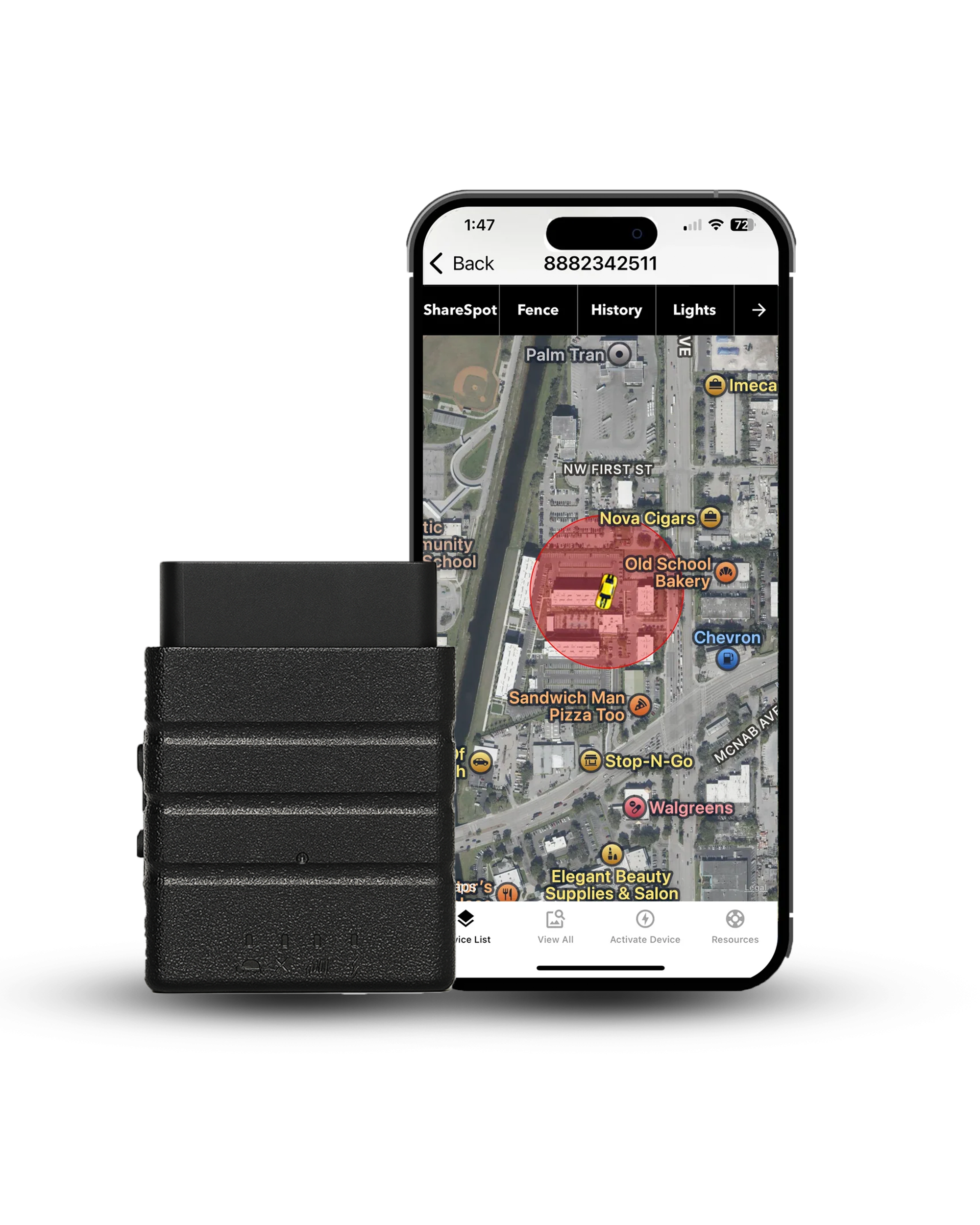
A plug-in tracker like the Konnect OBD2 GPS tracker runs on its own GPS chip and never touches the bus, so fake messages on the network can't fool it. Yank the tracker out of the port, and you get a tamper alert plus about 15 minutes of backup reporting.

- Live location every 3 seconds, where most trackers update once a minute
- Speed, geofence and tamper alerts on iPhone and Android
- A full year of trip history, plus a lifetime warranty
Cancel anytime.
What CAN Bus Means For An OBD2 GPS Tracker
CAN bus decides one thing for an OBD2 GPS tracker, whether the tracker reads your car's data or just borrows power from the port. Every plug-in tracker draws power from pin 16 and ground from pins 4 and 5, and data trackers also send requests onto the bus to pull engine readings. Konnect is power-only and never talks on the bus.


Some folks see that as a missing feature. I see it as the smartest call in the whole design.
A data tracker acts like a scan tool that never goes home, sending OBD2 requests to your ECUs all day. Constant requests can keep waking parked ECUs.
Polling the engine computer all day, on every truck in a fleet, can open the door to electrical headaches. Most business owners I talk to only want two answers anyway, where the truck is and where it has been.
A power-only design gives you those answers, plus a few bonuses.
- No requests on your CAN bus, so the tracker never wakes a sleeping ECU
- Fits most US cars and light trucks from 1996 on, whatever their protocol
- Location comes from its own GPS chip, not your car's speed sensor
- Accurate within 6 feet, with updates every 3 seconds while you drive
The trade-off is simple. You won't get trouble codes, RPM or fuel level from Konnect, and Teslas and most motorcycles aren't on the fit list. My guide to what data an OBD GPS tracker collects lays out what each type of tracker reads, so you can pick the right one for the job.
A dot on the map you can trust is what most people want, and the Konnect OBD2 GPS tracker does exactly that for $8.95 a month.
Pick a tracker that draws power from pin 16 and leaves your engine computer alone, then judge it by how often it updates.
Final Thoughts On CAN Bus
CAN bus connects your car's computers through two wires, while OBD2 gives scan tools a standard way to communicate with those computers. ISO 15765-4 defines the rules for that communication, making CAN-based OBD2 mandatory on US cars and light trucks from the 2008 model year onward.
After 15+ years working under dashboards across Southern California, I've seen how much these two wires handle. Engine data, transmission signals, braking information, and messages between dozens of control modules all travel across the same network.
If you're checking your car's protocol, remember pins 6 and 14 on the OBD2 port. If you're choosing an OBD2 GPS tracker, pay attention to whether it reads data from the CAN bus or simply draws power from the port.
I still find it impressive that a pair of twisted wires can keep an entire vehicle's electronics talking.

Konnect plugs into your OBD2 port in seconds, draws power from pin 16, and shows your car's location every 3 seconds, where most trackers update once a minute. Speed, geofence and tamper alerts, a year of trip history and a lifetime warranty, all for $8.95 a month.
Device $39.95. Free US shipping in discreet, plain packaging, 30-day money-back guarantee, cancel anytime.
DISCLOSURE: As an Amazon Associate, Konnect GPS earns from qualifying purchases.
About the Author

 Buy on Amazon