
How Accurate Is GPS? GPS Tracker Accuracy Explained
-
01
GPS is usually accurate within 3 to 5 meters under open sky
-
02
GPS receivers need at least four satellites to calculate your location
-
03
Tall buildings and dense trees reduce GPS accuracy by blocking satellite signals
-
04
Differential GPS and RTK GPS improve accuracy through real-time error correction
-
05
Proper installation and receiver quality improve real-world GPS tracking performance
How Accurate Is GPS Tracker? A Real-World Guide to GPS Accuracy
Chances are, you searched "how accurate is GPS" because something made you stop and question it. Maybe your GPS tracker showed your vehicle a few feet away from where it was parked. Maybe you're comparing trackers and want to know if the accuracy claims are actually true. Or maybe you just want to know whether you can trust the location before spending your money.
I've had that conversation with customers more times than I can count.
I'm Ryan Horban, and I've spent more than 15 years testing GPS trackers on personal vehicles, work trucks, rental fleets, trailers, and construction equipment. In this guide, I'll help you understand GPS accuracy, what causes those occasional location shifts, and what you can do to get the most reliable tracking possible.
By the time you finish reading, you'll know exactly what to expect from your GPS device and when a small location error is perfectly normal or a sign that something needs your attention.
GPS is typically accurate within 3 to 5 meters (10 to 16 feet) outdoors under open sky. Most consumer GPS devices calculate location using signals from at least four GPS satellites. Buildings, trees, tunnels, receiver quality, and atmospheric conditions can temporarily reduce GPS accuracy.

- USA based support
- Free US shipping
- Lifetime warranty
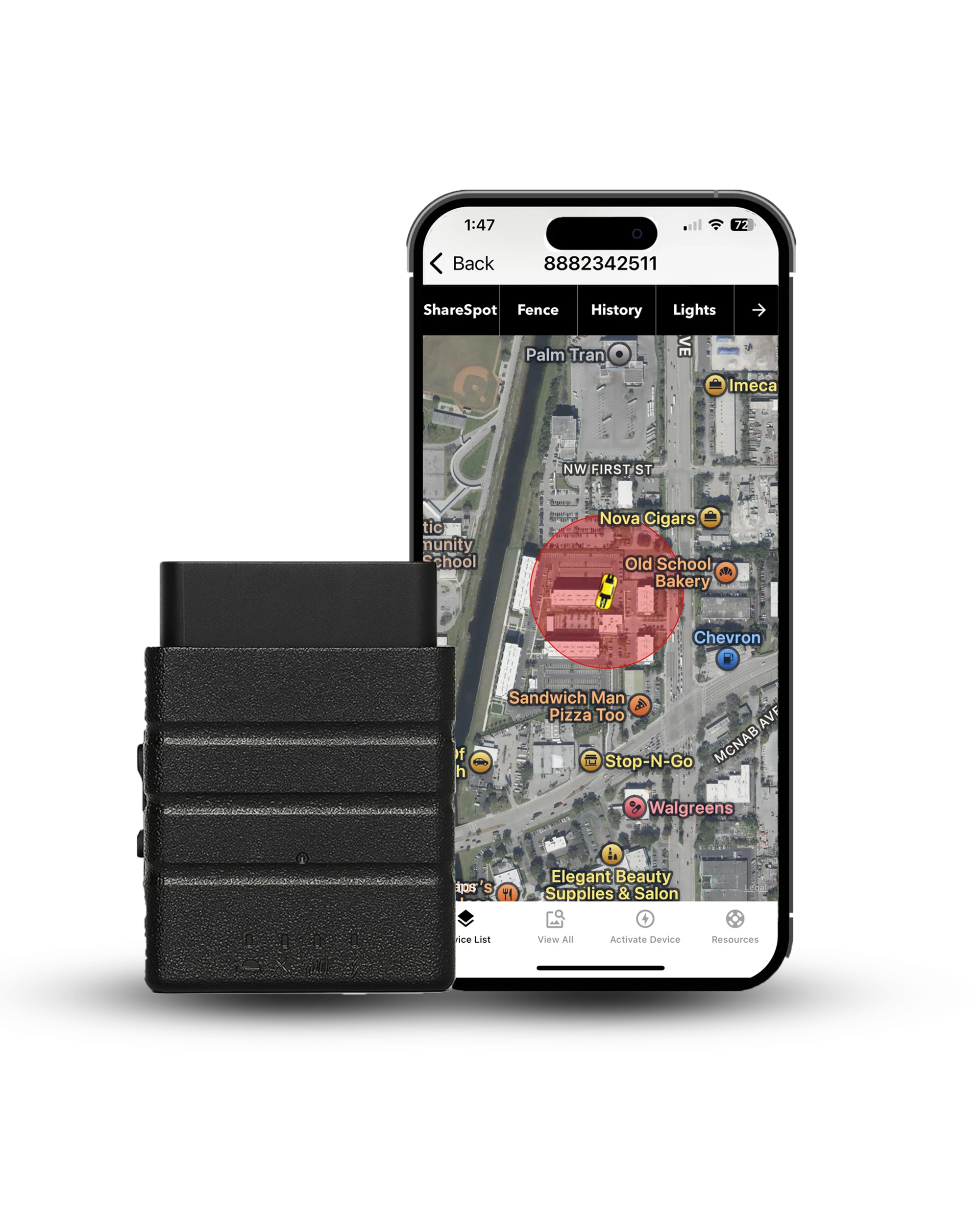
Real-time tracking with 3 second location updates
- Updates every 3 seconds: Live position while the vehicle is moving
- Plug and play: Into the OBD2 port under the dash, no tools
- Alerts and history: Speed and geofence alerts, a full year of trips
What Does GPS Accuracy Actually Mean?
GPS accuracy describes how close a GPS device's reported location is to its actual location. A smaller gap means better location accuracy. Most consumer GPS devices deliver accuracy within 3 to 5 meters (10 to 16 feet) outdoors when GPS receivers have a clear view of the sky and strong satellite signals.

I've found that many people confuse GPS accuracy with tracking performance. A GPS receiver may calculate an accurate location, but the tracker might send updates every 30 or 60 seconds. Good GPS accuracy doesn't always mean you're seeing live movement every second.
How GPS Calculates Your Location
GPS location calculation starts with the Global Positioning System, a network of GPS satellites orbiting Earth. Each satellite continuously transmits radio waves containing precise timing information from onboard atomic clocks.
Every GPS location starts with a simple process.
- Your GPS receiver combines those satellite signals, measures how long they take to arrive, and performs distance calculations to determine your location.
- A receiver needs signals from at least four satellites to calculate an accurate three-dimensional position.
The quality of those calculations depends on several factors, including satellite geometry, signal quality, receiver quality, and the environment around you. A clear view of the sky usually produces the best results, while tall buildings, dense trees, and other obstacles can reduce GPS precision by blocking or reflecting satellite signals.
RELATED GUIDE The distance calculation behind every GPS fix has a name, and it is not triangulation. Read moreKnowing where a GPS device is and knowing how often it reports that location are two different things. I see those mixed up all the time, so let's separate them before we go any further.
GPS Accuracy vs. Tracking Performance
GPS accuracy measures how close your GPS device is to the vehicle's actual location. Tracking performance measures how often that location is reported. Both work together, but they solve different problems.

I've had plenty of people tell me their GPS tracker wasn't accurate because the map looked a few seconds behind. After checking the tracker, I found the GPS receiver was calculating the correct location. The reporting interval simply wasn't set as frequently as they expected.
A quick comparison.
| GPS Accuracy | Tracking Performance |
|---|---|
| Shows how close the reported location is to the real location. | Shows how often the tracker sends location updates. |
| Usually measured in meters or feet. | Usually measured in seconds or minutes. |
| Depends on GPS satellites, receiver quality, and signal quality. | Depends on reporting settings and cellular connectivity. |
| Determines location precision. | Determines how smoothly movement appears on the map. |
A quick example makes the difference easier to see. A GPS tracker may locate your truck within a few feet, but if the tracker reports every 60 seconds, the map only refreshes once each minute. GPS accuracy hasn't changed. You're simply seeing location data less often.
Understanding that difference makes it much easier to judge how well a GPS tracker is performing. So accurate tracking performance depends on both, not one or the other.
How Accurate Is GPS?
GPS is typically accurate within 3 to 5 meters (10 to 16 feet) outdoors under clear sky conditions. Most consumer GPS devices calculate location using signals from at least four GPS satellites, making GPS accurate enough for navigation, fleet management, emergency services, personal safety, and everyday vehicle tracking.
Those numbers match what I've seen after testing GPS trackers on personal vehicles, work trucks, rental fleets, and equipment for more than 15 years. A quality GPS receiver with a clear view of the sky delivers reliable location accuracy in most everyday situations.
The radius GPS-enabled smartphones are typically accurate to under open sky, per the U.S. government's own published figure. The committed worst case for the Standard Positioning Service is wider.
Verified against GPS.gov, GPS accuracy

Typical GPS Accuracy by Environment
GPS accuracy changes with your surroundings. Open areas usually deliver the best results because GPS receivers can communicate with more satellites. Downtown streets, dense forests, and indoor spaces often reduce location accuracy.
What you can generally expect.
| Environment | Typical GPS Accuracy |
|---|---|
| Open outdoor areas | 3 to 5 meters (10 to 16 feet) |
| Suburban neighborhoods | 3 to 7 meters (10 to 23 feet) |
| Urban canyons | 5 to 15 meters (16 to 49 feet) |
| Dense forests | 10 to 20 meters (33 to 66 feet) |
| Indoors or parking garages | GPS signals may be weak or unavailable |
| RTK GPS | Accurate to within a few centimeters |
Your surroundings are only part of the equation. Receiver quality, satellite geometry, atmospheric conditions, and environmental factors also influence GPS accuracy every time your device calculates a location. Higher-quality GPS receivers process satellite signals more efficiently, which often leads to better accuracy in challenging conditions where entry-level devices may struggle.
I've seen the same GPS tracker perform differently just by changing locations.
What Affects GPS Accuracy?
GPS accuracy depends on several factors, including satellite geometry, signal quality, receiver quality, atmospheric conditions, and the environment around your GPS device. When one or more of these change, location accuracy can temporarily improve or decrease.

I've found that most tracking problems don't start with the GPS tracker. More often, the conditions around the receiver change, and the reported location changes with them.
1. Satellite Geometry Makes a Bigger Difference
GPS receivers calculate your location using signals from at least four GPS satellites. Better satellite geometry gives the receiver stronger distance calculations because it can compare signals from multiple satellites. When fewer satellites are available or they're grouped too closely together, GPS precision naturally drops.
2. Buildings, Trees, and Tunnels Get in the Way
GPS signals need a clear path between the satellite and your receiver. Tall buildings, urban canyons, parking garages, tunnels, and dense tree cover can block or reflect satellite signals, creating multipath errors that temporarily reduce location accuracy.
Those errors usually disappear once the receiver regains a clearer view of the sky.
3. Receiver Quality Also Counts
Buying a more expensive GPS device doesn't always guarantee better GPS accuracy.
A high-quality GPS receiver usually processes satellite signals faster and filters interference more effectively, but installation and antenna placement play just as big a role. I've seen mid-range GPS trackers outperform premium models simply because they were installed correctly.
4. Other Conditions and Environmental Factors Can Affect GPS Accuracy
Several smaller factors also influence how accurately your GPS device calculates its location.
- Atmospheric conditions can slightly delay GPS signals before they reach the receiver.
- Signal interference from nearby electronics, other radio signals or structures may reduce signal quality.
- Antenna quality affects how efficiently the receiver captures satellite signals.
- Environmental factors such as heavy foliage or steep terrain can temporarily reduce accuracy.
Most of these changes only affect GPS for a short time.
Why GPS Accuracy Changes
GPS accuracy changes because your GPS receiver depends on all above discussed factors like strong satellite signals, good satellite geometry, and favorable environmental conditions. When any of those change, location accuracy can temporarily decrease.
I've found that most GPS tracking issues aren't caused by faulty hardware. More often, the receiver is working correctly, but outside conditions affect how well it communicates with GPS satellites.

Modern GPS Technology Keeps Improving
Modern GPS technology continues to improve location accuracy through Differential GPS (DGPS), RTK GPS, WAAS, and other augmentation systems. These systems use reference stations, ground stations, and real-time corrections to reduce positioning errors. Professional GPS equipment can achieve accuracy within a few centimeters, while most consumer GPS devices remain accurate within a few meters.
Good GPS accuracy comes from several systems working together, not just stronger satellites.
Can You Trust GPS for Everyday Tracking?
Yes. GPS is accurate enough for everyday tracking, navigation, fleet management, emergency services, and most personal or business applications. Most consumer GPS devices deliver reliable location data when GPS receivers have a clear view of the sky and a strong satellite connection.

I've trusted GPS trackers to monitor personal vehicles, rental fleets, trailers, and business equipment for years. Small location shifts happen from time to time, especially around tall buildings or parking garages, but they rarely affect the bigger picture. A quality GPS tracker still gives you dependable location data when you need it.
GPS works well for everyday tasks because it provides reliable location data for these jobs.
- Vehicle tracking: Monitor your vehicle's location throughout the day and review where it has traveled.
- Fleet management: Track multiple vehicles, improve dispatching, and monitor driver activity more efficiently.
- Asset tracking: Keep equipment, trailers, and valuable assets visible across different job sites.
- Theft recovery: Help locate a stolen vehicle faster by sharing recent location data with law enforcement.
- Personal safety: Check a loved one's location or respond more quickly during roadside emergencies, whether that is a teen driver or an older parent still driving.
- Turn-by-turn navigation: Receive accurate location updates that support everyday driving and route guidance.
For most people, GPS doesn't need survey-grade precision to be useful. Reliable location data within a few meters is more than enough for everyday tracking and navigation.
When Should You Be Concerned?
A single inaccurate GPS location usually isn't a reason to worry. Temporary location shifts happen because GPS signals can be blocked or reflected by buildings, tunnels, dense trees, or other environmental conditions. Most GPS devices return to normal once signal quality improves.

After installing and testing GPS trackers for years, I've learned to look for patterns instead of one-off errors. An occasional location jump is normal. Repeated problems in open areas deserve a closer look.
Take a closer look if you notice any of these signs.
- Repeated inaccurate locations: The GPS device regularly reports the wrong location, even with a clear view of the sky.
- Long gaps between updates: Location data stops updating despite good power and cellular coverage.
- Incorrect trip history: The recorded route doesn't match where the vehicle actually traveled.
- Frequent signal loss: GPS tracking drops in places where strong satellite signals should be available.
Most of these problems have a simple fix. Checking the installation, antenna placement, power supply, or tracker settings often restores normal GPS performance without replacing the device.
How to Improve GPS Accuracy
You can't control GPS satellites, but you can improve how accurately your GPS device receives and reports location data. A few simple changes often make a bigger difference than replacing your GPS tracker.

I've solved plenty of GPS accuracy problems without installing new hardware. Most fixes come down to better placement, stronger signal reception, and the right tracker settings.
Start with these simple improvements.
- Install the GPS tracker correctly: Follow the manufacturer's recommended mounting location and avoid placing the device beneath large metal surfaces that can weaken GPS signals.
- Give the receiver a clear view: GPS receivers perform better when satellite signals reach the antenna with fewer obstructions.
- Reduce the reporting interval: More frequent location updates create smoother tracking and improve the overall tracking experience.
- Keep your device updated: Firmware updates often improve GPS signal processing, receiver performance, and overall stability.
- Check the power supply: Low battery voltage or unstable power can interrupt tracking and delay location updates.
Small adjustments often produce noticeable improvements. I've seen GPS trackers that appeared unreliable perform consistently again after nothing more than a better installation or a simple settings change.
Professional GPS systems go even further.
Technologies like Differential GPS (DGPS), RTK GPS, WAAS, and other augmentation systems improve accuracy through ground stations, reference stations, and real-time error correction. Those systems are commonly used for land surveying, construction, precision agriculture, and marine navigation, where location accuracy is measured in centimeters instead of meters.
For everyday driving, vehicle tracking, and fleet management, though, a quality GPS tracker that's installed correctly already provides the accuracy most people need.
Is a GPS Tracker More Accurate Than My Phone?
Not usually. A dedicated GPS tracker and a modern smartphone often deliver similar GPS accuracy because both use GPS signals from the same Global Positioning System satellites. A GPS tracker performs better over time because it's built for continuous tracking, more reliable location data, and long-term monitoring.

I've tested both on personal vehicles, work trucks, rental fleets, and equipment over the years. Under open sky, the location accuracy is often nearly identical. The difference shows up after hours of driving, overnight parking, or long trips where consistent reporting becomes more important than pinpoint GPS precision.
A side-by-side comparison of GPS tracker against smartphone tracking accuracy.
| Feature | Dedicated GPS Tracker | Smartphone |
|---|---|---|
| Primary use | Continuous vehicle or asset tracking | Navigation and everyday apps |
| GPS accuracy | Similar under open sky | Similar under open sky |
| Location reporting | Configurable reporting intervals | Depends on the app and operating system |
| Power source | Vehicle power or dedicated battery | Phone battery |
| Long-term tracking | Designed for continuous monitoring | Battery and background restrictions apply |
| Theft recovery | Hidden and always tracking | Limited if the phone is switched off, removed, or loses power |
The right choice depends on how you plan to use it. For everyday driving, I usually tell people to use the smartphone already in their pocket. If you need accurate tracking, trip history, theft recovery, or fleet management, a dedicated GPS tracker is the better tool because that's exactly what it was designed to do.
RELATED GUIDE I ran a tracker against three phone apps over the same 200-mile route. Uptime came out 98.7 percent against 61. Read moreGPS Accuracy vs. Cellular Coverage
GPS accuracy and cellular coverage are two different systems. GPS uses satellite signals to calculate your location, while a cellular network sends that location data to your app or tracking platform.

I've had customers tell me their GPS tracker stopped working because they drove through an area with no cell service. Most of the time, the GPS receiver never lost the vehicle's location. The tracker simply couldn't upload the GPS data until it reconnected to the cellular network.
A simple example makes the difference easier to understand.
- GPS: Calculates your location using signals from GPS satellites.
- Cellular network: Sends your location data to your phone or tracking dashboard.
Drive through a remote area with poor cellular coverage, and your GPS device can continue recording accurate location data. Once the cellular connection returns, the tracker uploads those stored locations automatically.
A delayed update doesn't always mean poor GPS accuracy. Sometimes the location is accurate, but the network delivers it a little later.
RELATED GUIDE Your tracker keeps calculating position with no cell service at all, then uploads the whole trip once the network returns. Read moreCommon Myths About GPS Accuracy
GPS technology has improved dramatically over the years, but I still hear the same misconceptions from customers. Clearing them up makes it much easier to understand what your GPS device can and can't do.

Myth 1: GPS Is Always 100% Accurate
GPS is highly accurate, but no GPS device delivers perfect location accuracy every second of the day. Most consumer GPS devices stay within 3 to 5 meters (10 to 16 feet) outdoors, although GPS accuracy changes with satellite geometry, receiver quality, and environmental conditions.
Myth 2: GPS Stops Working Without Cell Service
A lot of people assume GPS depends on a cellular network. It doesn't.
GPS receivers calculate your location using GPS satellites, while the cellular network simply sends that location data to your app or tracking platform. A GPS tracker can continue recording locations without cell service and upload the data once the connection returns.
Myth 3: Bad Weather Ruins GPS Accuracy
Rain, snow, and cloudy skies have very little effect on GPS accuracy. I've seen far bigger problems caused by tall buildings, tunnels, dense tree cover, and urban canyons because they block or reflect GPS signals. Those conditions reduce signal quality much more than normal weather.
Knowing what really affects GPS accuracy makes it easier to separate normal GPS behavior from an actual tracking problem.
The Bottom Line On GPS Accuracy
For most people, GPS is accurate within 3 to 5 meters (10 to 16 feet) under normal outdoor conditions. That level of GPS accuracy is more than enough for navigation, vehicle tracking, fleet management, emergency services, and everyday driving.
After testing GPS trackers on personal vehicles, work trucks, rental fleets, and equipment for more than 15 years, one lesson has stayed the same. A quality GPS tracker, proper installation, and a clear view of the sky usually have a bigger impact on everyday tracking than chasing perfect GPS precision.
Small location shifts happen from time to time, and that's completely normal. What you should expect is reliable location data that consistently tells you where your vehicle, equipment, or assets are. That's exactly what modern GPS technology is designed to deliver.
If you're choosing a GPS tracker, don't focus only on the accuracy numbers. Receiver quality, reporting intervals, installation, and the features that fit your needs often make a much bigger difference in real-world performance.
I've seen mid-range GPS trackers outperform premium models simply because they were installed correctly. Placement beats price more often than anyone selling you a tracker will admit.
Sources
- GPS.gov, GPS accuracy and the Standard Positioning Service performance standard
- GPS.gov, the GPS space segment, constellation and orbital altitude
- Federal Aviation Administration, Wide Area Augmentation System
- NOAA National Geodetic Survey, Continuously Operating Reference Stations

Konnect plugs into the OBD2 port in under a minute and reports a fresh position every 3 seconds, not every 30 or 60. Speed and geofence alerts, a full year of trip history, coverage across 150+ countries. Lifetime warranty and USA-based support.
As an Amazon Associate, Konnect GPS earns from qualifying purchases.
About the Author

 Buy on Amazon