
GPS Tracking Laws in California: What's Legal, What's a Crime (2026)
-
01
Penal Code 637.7 makes tracking a person without consent a misdemeanor in California
-
02
The registered owner, lessor or lessee is carved out. That exception does most of the work
-
03
Co-owned vehicles are the genuine gray area, and one 2021 case is the reason
-
04
Employers own more room on company vehicles, but written notice is the defensible standard
-
05
A statewide location privacy bill died in early 2026, and similar proposals will return
I'm Ryan Horban. For the last 15 years I've worked with GPS vehicle trackers, fleet tracking devices, and commercial GPS tracking systems. A good deal of it here in California.
California's rules are more specific than most states. One statute does the heavy lifting, and a handful of court decisions shape how it gets applied.
Here is where the line actually sits, and where it genuinely is not clear.
The statutePenal Code 637.7, and the exception that does the work.
Who can legally trackFive situations, and which one is unsettled.
Where it becomes a crimeThe line, and the civil exposure behind it.
Employer rulesMore room on company vehicles, with conditions.
The three casesAgnelli, Jones and Otonomo, and what each settled.
AB 1355The bill that died, and why it still matters.
Connected carsSB 1394 and SB 719, and why they're different from PC 637.7.
If you split time between states, our state-by-state guide to GPS tracking laws covers how California's rules compare to the other 49.
Tracking a vehicle you own is legal in California. Installing a tracker on a vehicle you do not own is a misdemeanor under Penal Code 637.7. That is, without consent from the registered owner, lessor or lessee.
Employers generally have more room on company vehicles, because they are the owner or lessee. Written notice is still the defensible standard. Co-owned vehicles are the one genuine gray area.

Everything here assumes a vehicle you own or hold clear authority over. Putting a tracker on a partner's, an ex's or a family member's car is a crime in California. It can also escalate into stalking charges far heavier than 637.7 alone.
Found a tracker on your own vehicle and do not know who put it there? Photograph it in place and contact local law enforcement before you remove it yourself. Removing it tells the person you found it, which can escalate things. The National Domestic Violence Hotline is free and confidential on 1-800-799-7233, and SPARC publishes guidance for exactly this.

- USA based support
- Free US shipping
- Lifetime warranty
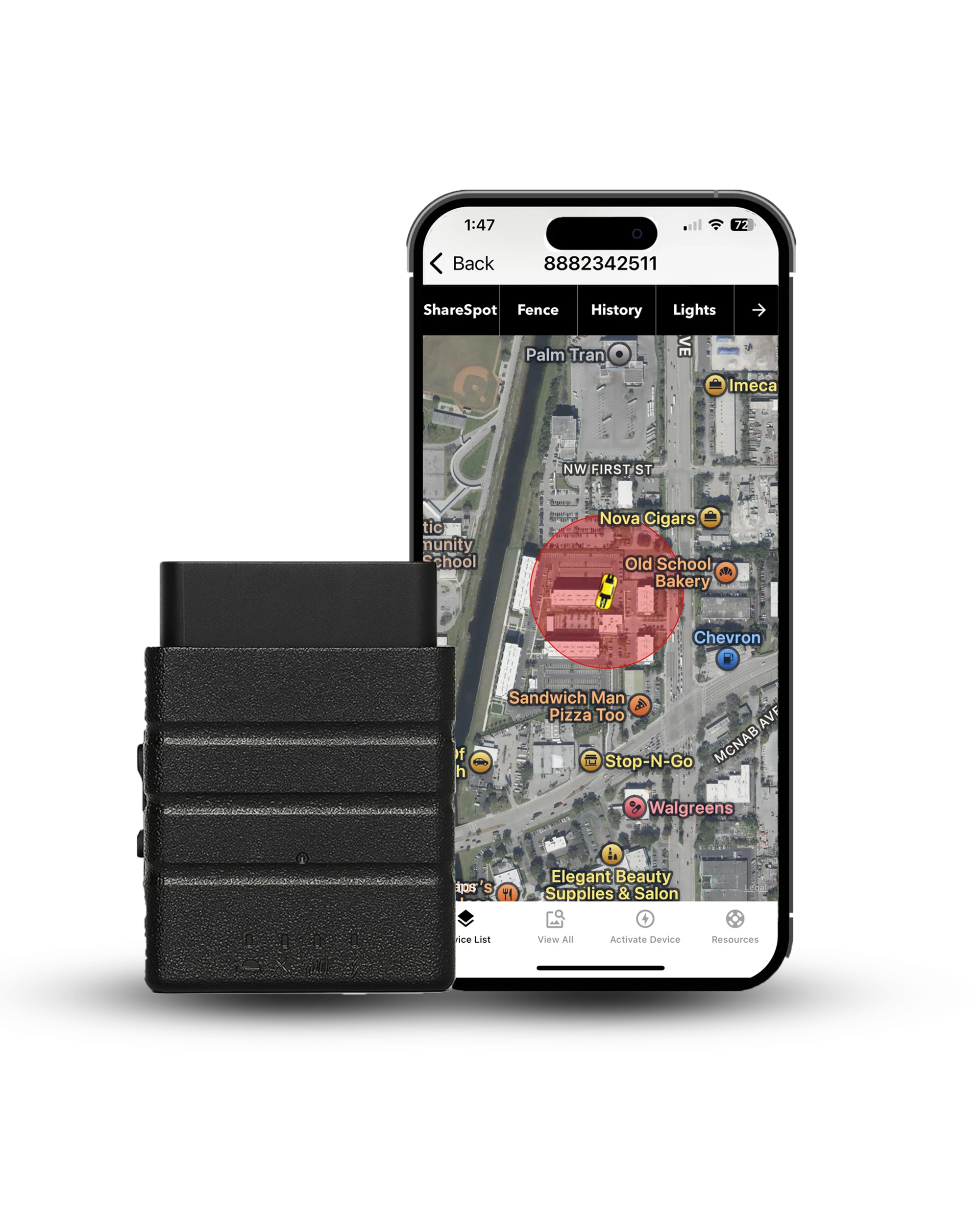
Real-time tracking with 3 second location updates
- Updates every 3 seconds. Live position while the vehicle is moving
- Plug and play. Into the OBD2 port under the dash, no tools
- Alerts and history. Speed and geofence alerts, a full year of trips
Penal Code 637.7 (PC 637.7), The Core Statute
California Penal Code 637.7 is the statute that governs GPS tracking in the state. It applies to individuals, businesses, employers and rental operators alike.
The rule itself is short. No person or entity may use an electronic tracking device to determine the location or movement of a person. Then subsection (b) carves out the exception that does most of the work.
"(a) No person or entity in this state shall use an electronic tracking device to determine the location or movement of a person. (b) This section shall not apply when the registered owner, lessor, or lessee of a vehicle has consented to the use of the electronic tracking device with respect to that vehicle. (c) This section shall not apply to the lawful use of an electronic tracking device by a law enforcement agency."
Subsection (d) defines it as a device attached to a vehicle or other movable thing. It reveals location by transmitting electronic signals. That one word, attached, decides a surprising amount. Aftermarket hardware is covered. Equipment built in at the factory is a different question, as the Otonomo case below shows.
What a violation can cost.
- A misdemeanor charge for each violation
- Up to six months in county jail
- A fine of up to $1,000
- Civil damages under Penal Code 637.2, the greater of $5,000 per violation or three times actual damages
- Grounds for license revocation where the person tracking holds a professional license
Statutory civil damages a California court can award per violation. On top of any criminal penalty, and separate from actual damages.
Verified against Cal. Penal Code 637.2 and 637.7
Worth sitting with that number. The civil exposure is the part most people never consider. It does not require anyone to be prosecuted first.
The statute dates to the late 1990s. Its legislative history points at a specific problem, private investigators fixing devices to other people's cars. How that language applies to shared cars and business fleets is what the courts have been working out since.
Who Can Legally Track A Vehicle

Ownership decides it. Here is how the common situations break down.
| Situation | Legal under 637.7 | What you need |
|---|---|---|
| Vehicle you own outright | Yes | Nothing beyond being the registered owner. Covers a teen driver's car titled in your name, a second family vehicle, or theft protection on your own car. |
| Vehicle you co-own | Unsettled | Written consent from every registered owner. One appellate division ruling found the statute unclear here, which is not the same as finding co-owner tracking lawful. |
| Company vehicle you own or lease | Yes | Written notice to the employees who drive it, ideally acknowledged in a handbook or onboarding form. |
| Rental vehicle in your own fleet | Yes | Disclosure in the rental agreement, so the renter knows before they drive away. |
| Someone else's personal vehicle | No | Consent from the registered owner, lessor or lessee. Without it, installing a tracker is a misdemeanor whatever your reason. |
Co-owned vehicles, the real gray area

People v. Agnelli (2021)
A husband in divorce proceedings placed a tracker on a vehicle he and his estranged wife still co-owned. He was charged, tried and convicted under 637.7. On appeal, the appellate division of a California superior court reversed. It held the statute unconstitutionally vague as applied to him. Neither the text nor the history says whose consent controls when a vehicle has two registered owners.
What it did NOT do. Say co-owner tracking is legal. The finding was that the law fails to give clear notice in that situation. An appellate division of a superior court also does not bind courts statewide. Agnelli still faced separate charges for violating a protective order.
Read practically. Co-owned tracking carries real uncertainty that tracking a car you own outright does not. Documented consent from every registered owner is the safer path by a wide margin.
Rental fleets
A rental company is the registered owner, so it can generally track a vehicle it rents out. Disclosure in the rental agreement is standard among major operators and reduces exposure. Our guide to the best OBD GPS tracker for rental cars covers device choice alongside those practices.
Where It Becomes A Crime
Installing a tracker on a vehicle you do not own is a misdemeanor. That means without consent from the owner, lessor or lessee. Your relationship to the owner does not change that, and neither does your reason.
Is Putting A Tracker On Someone's Car A Felony In California?
No, not on its own. A first PC 637.7 violation is a misdemeanor, and the law does not step up to a felony on a second offense either, so anyone telling you otherwise has the statute wrong.
Where felony charges actually show up is stalking. If the tracking is part of a pattern that makes someone fear for their safety, prosecutors can add PC 646.9 alongside 637.7. Stalking is a wobbler, meaning a DA can file it as either a misdemeanor or a felony, and it becomes an automatic felony if it breaks a protective order or follows an earlier stalking conviction.

- A tracker on a partner's or ex-partner's car without their knowledge
- A device on a friend's or adult family member's vehicle without asking
- Tracking a car registered solely to someone else, however good the intention
- Assuming that paying for the car, or driving it, carries the same rights as the registered owner
- Leaving a tracker in place after the owner has withdrawn consent
- Check the registration before you buy a device, not after you install one
- Written consent from every registered owner on a shared car
- Tell teen drivers the tracker is there. Legal, honest, and it works better anyway
- Employee and renter notice in writing, in something they sign or acknowledge
- Remove the device when ownership changes or consent is withdrawn
Tracking that crosses into monitoring a specific person can also engage California's stalking statutes. That is especially true with a current or former partner. Those carry their own, generally heavier, penalties. That is a different category of exposure from a standalone 637.7 charge.
Employer Rules
Employers tracking company-owned vehicles stand on firmer ground than an individual tracking someone else's car. The employer is usually the registered owner or lessee, which falls inside the 637.7(b) exception. California practice still pushes hard toward transparency.

Location tracking through work-issued phones sits in the same policy area even though it is not a dedicated tracker. Our guide on OBD GPS trackers for company cars goes deeper on notice and privacy.
Most guides tell you AB 984 requires notice before any GPS tracking of employees. That overstates it. AB 984's notice rules attach specifically to "alternative devices," meaning digital license plates and similar DMV-approved swaps for a metal plate. A standalone OBD2 tracker or magnetic unit sits outside that specific law.
The 637.7(b) owner exception is still what does the real work on a company-owned vehicle.
The California Consumer Privacy Act still matters here, though. The old CCPA carve-out for employee data expired on January 1, 2023, so employees now have the same notice and access rights over their own location data as any other consumer. In practice, that means telling employees in writing what you collect, why, and how long you keep it, before the tracker ever goes on.
The California customers who end up in trouble almost never set out to break a law. What I see is somebody who paid for the car, or drives it daily, assuming that settles it. The registration settles it. Pull the title and read whose name is on it. If there is a second name, get that person to say yes in writing first.
The Three Cases That Shape It
United States v. Jones
Police tracked a suspect's vehicle for 28 days. The Supreme Court held that attaching the device and monitoring movements was a Fourth Amendment search. The rationale was trespass.
Two details get misreported constantly. Investigators did have a warrant, but installed the device after it expired and in the wrong jurisdiction. And the Court expressly left open whether this kind of search always requires one.
Why it matters less here than people think. Jones governs government conduct. The Fourth Amendment restrains state actors, not private citizens. A private person's exposure comes from 637.7, the stalking statutes and civil privacy claims instead.
Mollaei v. Otonomo
A California driver sued the data broker Otonomo under 637.7. The claim was that it collected and resold location data from telematics units built into cars at the factory. The complaint was dismissed, and in April 2025 the Ninth Circuit affirmed.
The reasoning turned on that one word from the definition. A unit installed during manufacturing is part of the vehicle, not a device attached to it. So it falls outside 637.7 entirely.
The takeaway runs opposite to the headline. Rather than expanding the statute to cover connected-car data, the courts narrowed it to the legislature's original target. OBD2 plug-ins, magnetic trackers and hardwired units are squarely covered. Factory telematics sit in a separate lane.
AB 1355, The Bill That Stalled
Assembly Bill 1355 was introduced in February 2025 by Assemblymember Chris Ward. Known as the California Location Privacy Act, it would have restricted how businesses collect, use and sell location data. Phone and app data through to connected vehicles.

As proposed, covered businesses would have had to do four things.
- Collect location data only where necessary to deliver something the person actually requested
- Give clear notice at the point of collection
- Publish a location privacy policy with retention limits
- Face civil penalties, including Attorney General enforcement
AB 1355 was filed with the Chief Clerk on February 2, 2026 and died with the session. Ward had already tried a second route in June 2025, amending similar language into AB 322. This policy area is not finished.
Verified against the California legislative tracker, AB 1355
Nothing in AB 1355 would have changed the rules for an individual tracking their own car. It targeted businesses monetizing location data at scale, which is a different problem from a parent and a teenager.
SB 1394 And The New Rules For Connected Cars
PC 637.7 covers a device you physically attach to a car. A separate California law now covers the GPS built into the car itself, and it exists for one specific reason: stopping an abuser from tracking a survivor through the vehicle's own connected services.
Senate Bill 1394, signed in 2024, requires automakers to give a person a way to cut off someone else's remote access to a connected vehicle, like the location sharing in an app such as OnStar or FordPass. Whoever asks has to prove they own the car, hold the lease, or have a divorce decree or protective order naming them. Automakers already have to act on a verified request within two business days.
What changed in 2026. The law also set a July 1, 2026 deadline for an in-vehicle button that disables location sharing from inside the car. Automakers couldn't build that in time, so Senate Bill 719 replaced the single hard date with a rolling schedule tied to model year, running out to 2031. The two-business-day access cutoff from SB 1394 was never touched.
None of this changes anything for a car you already own outright and track yourself with a plug-in device like an OBD2 tracker. SB 1394 and SB 719 govern the connected services built in by the manufacturer, not aftermarket GPS you install.
Every state handles this a little differently, and the National Conference of State Legislatures (NCSL) keeps a running table of who requires what. Worth a check if a tracked vehicle ever crosses state lines. For California, five habits keep you clear.
Staying On The Right Side Of It

The Bottom Line
California's law is more specific than most states. The core rule is still short enough to hold in your head. Track vehicles you own. Get consent when you do not. Give notice when tracking touches employees, renters or a shared car.
Agnelli left genuine uncertainty around co-owned vehicles. Otonomo confirmed that 637.7 aims at aftermarket devices rather than factory telematics. AB 1355 signals that legislators are watching location data generally, even though that bill died.
Where people run into trouble is almost never a decision to break the law. It comes from assuming that paying for a car grants tracking rights. Or from skipping consent on a shared one. Get ownership and consent right and this is straightforward.
GPS tracking laws are subject to change, so use this article as a guide and not a legal document. If you are worried you might be doing something illegal, speak to a lawyer.
This guide is general information and is not a substitute for advice from a licensed California attorney. Statutes change, court decisions shift, and how any rule applies to your situation can vary. If you are unsure whether your tracking plans are lawful, talk to a lawyer before installing a device.
Last checked against current California law in September 2026.
Sources
- California Penal Code 637.7, electronic tracking devices
- People v. Agnelli, Cal. Super. Ct. App. Div. (2021)
- United States v. Jones, 565 U.S. 400 (2012)
- Mollaei v. Otonomo Inc., class action complaint
- Mollaei v. Otonomo Inc., Ninth Circuit memorandum, April 22, 2025
- California Legislature, AB 1355 text and status

Konnect plugs into the car titled in your name. Three-second real-time location, speed and geofence alerts, a full year of trip history. $39.95 from $99.95, with a lifetime warranty and USA-based support.
As an Amazon Associate, Konnect GPS earns from qualifying purchases.
About the Author

 Buy on Amazon