
OBD GPS Tracker for Company Cars: Employee Privacy Laws
-
01
OBD GPS tracking is legal for company vehicles with proper use
-
02
Written notice is what several states actually require, not consent
-
03
Off-hours tracking increases privacy concerns and potential disputes
-
04
A personal vehicle is a different question and needs written consent
-
05
Clear policies prevent misuse of tracking data and conflicts
As an Amazon Associate, Konnect GPS earns from qualifying purchases.

An OBD GPS tracker for company cars is legal in most cases, but employee privacy rights depend on how the device is used inside a company vehicle. Businesses rely on fleet tracking and real-time location to monitor vehicles, improve driver safety, and manage operations. Consent, transparency, and clear boundaries decide whether that tracking stays compliant.
This guide covers how OBD GPS tracking works, what a tracker collects and what it does not, and where employee privacy rights come into play. You will also see how to run a tracking program in a way that supports safe driving and protects both your business and your team.
I'm Ryan Horban, and I've spent 15+ years working with GPS vehicle trackers, fleet tracking devices, and commercial GPS tracking systems across real-world fleets. I've worked closely with fleet managers using OBD2 port trackers, monitoring driver behavior, route history, and idling time, and I've also seen how poor setup or lack of policy can lead to legal issues.
Quick answer: is tracking employees legal?
Yes, when the vehicle is business-owned, used for work, and employees have been told. GPS tracking on company-owned vehicles is legal in all fifty states. Legal risk rises sharply when tracking involves personal vehicles, hidden devices, or off-hours monitoring with no policy behind it.
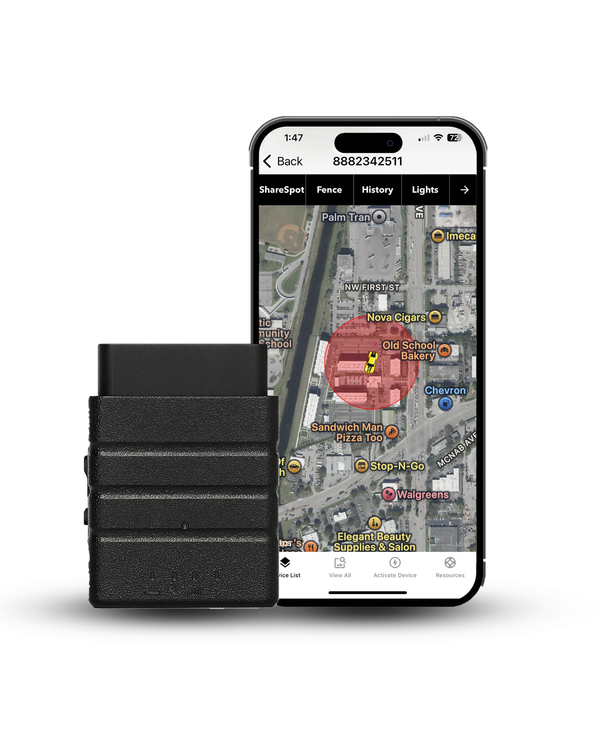
Konnect OBD2 GPS Tracker
Plug it into any OBD2 port and get real-time location, speed and geofence alerts, and up to a year of trip history. No wiring, no downtime, no vehicle off the road while somebody installs it.
$39.00 on sale, regularly $99.00
What Is an OBD GPS Tracker in Company Cars?
An OBD GPS tracker is a small device that plugs into a vehicle's OBD2 port and sends real-time location data to a fleet tracking system. Most company vehicles already have this port under the dashboard. You plug the device in, and within seconds it starts reporting. No wiring, no downtime, and a fleet manager can open the dashboard and see where a vehicle is and where it has been.
Live position
Where every vehicle is right now, refreshed fast enough to be useful for dispatch rather than for a report the next morning.
Trip history
Where a vehicle has been, stored long enough to settle a billing dispute or check whether a route is running the way it should.
Speed alerts
An email or text when a vehicle exceeds the threshold you set, which is the single most useful safety signal in the set.
Geofence alerts
A boundary drawn on the map, with a notification when a vehicle crosses it. Useful for yard departures and after-hours movement.
The device sits in plain view inside the vehicle, and most drivers know it is there. That visibility changes expectations, because once a system can follow vehicles this closely, questions about employee privacy start to matter.
Why Konnect Leaves Fuel and Idle Polling Out on Purpose
Plenty of buying guides put idle-time alerts, harsh-braking scores, and fuel-level analytics at the top of the feature checklist. Konnect does not do those, and the reason is a design decision rather than a gap.
Pulling fuel, idling, and harsh-braking data means a device polling the vehicle's engine control unit continuously, all day, on every vehicle in the fleet. Polling that hard does leave open the potential for electrical issues. Konnect was designed and manufactured to leave that out, on the reasoning that most businesses simply want to know where their vehicles are and where they have been.
So the honest split looks like this. Location data on its own solves route inefficiency, unauthorized use showing up in trip history, speeding caught by alert, yard departures caught by geofence, and a tracker being unplugged caught by tamper alert. Idle-time alerts, driver-behavior scorecards, and fuel-level analytics need deeper engine integration, and if your fleet genuinely runs on behavior scoring, a deep-ECU platform is the right tool. Go in knowing what that continuous polling asks of your vehicles.
Related readingHow OBD GPS trackers reduce fuel costs for fleetsIs It Legal to Track Employees Using OBD GPS Trackers?

Yes, tracking employees with an OBD GPS tracker is legal when the vehicle is owned by the business, used for work, and employees have been informed. The risk starts when any of those three conditions changes.
- Company-owned vehicles are generally allowed, in every state
- Personal vehicles require clear consent from the employee
- Hidden tracking creates legal problems and destroys trust at the same time
- Off-hours monitoring is the area most likely to be restricted or disputed
Most companies use tracking for driver safety, fleet visibility, and route planning. Those are valid business reasons. Problems show up when tracking shifts from work-related use toward monitoring a person, and a fleet manager who explains up front how location data and trip history get used avoids most of them before they start.
Key Laws That Affect Employee GPS Tracking

There is no single rule that applies everywhere. A mix of federal law and state statutes shapes what companies can and cannot do, and the laws that exist focus on three things: who owns the vehicle, what the employee was told, and how the data gets used.
Federal law
No federal statute directly governs GPS tracking of employees. Two points are worth knowing. The Electronic Communications Privacy Act governs the interception of wire, oral, and electronic communications, which is a narrower question than vehicle location and rarely the operative law for a fleet tracker. And United States v. Jones is frequently cited in this context but constrains government searches, not private employers. The Fourth Amendment restrains state actors. A private company's exposure comes from state statutes and civil claims instead.
State law
State law is where the real requirements sit, and the most common mistake is calling them consent laws when most are notice laws. Worth knowing before you read any state-by-state list: only one of these statutes was actually written about vehicles.
New Jersey is the one that names vehicle tracking directly. N.J.S.A. 34:6B-22 took effect in April 2022 and requires written notice before an employer knowingly uses a tracking device in a vehicle used by an employee. Read that phrasing carefully, because it covers a vehicle the company owns and a vehicle the employee owns alike, which is broader than any other state. Penalties run to $1,000 for a first violation and $2,500 for each one after.
Connecticut, Delaware and New York require notice for electronic monitoring, but the statutes were written for phones and computers. Conn. Gen. Stat. 31-48d reaches furthest, defining electronic monitoring as collecting information on an employer's premises about employee activities by any means other than direct observation. 19 Del. C. 705 and New York Civil Rights Law 52-c both address telephone, email and internet monitoring specifically. Whether vehicle GPS falls inside them has not been settled, and employment attorneys generally advise treating notice as required rather than betting on the narrow reading.
California restricts tracking a person, with an ownership exemption. California Penal Code 637.7 makes it an offense to track a person's location without consent, but exempts the registered owner or lessee of the vehicle. A company tracking trucks it owns generally sits inside that exemption.
Off-hours use and mixed-use vehicles are where written consent becomes the defensible standard everywhere, whatever your state's minimum happens to be.
Employee Privacy Rights You Can't Ignore

Employees have real privacy interests even in a company vehicle, and they center on awareness, consent, and limits. At a minimum, an employee should know that a tracker is installed, what it collects, how that data will be used, and who can see it.
Off-duty privacy is where most disputes begin. If a driver takes a company vehicle home, continuous tracking exposes personal movement, and that stays true even though the vehicle belongs to the company.
Here is how it usually goes wrong. A delivery driver finishes a shift and drives home in a company van. The tracker keeps reporting overnight. The next morning a manager asks about a personal stop made at nine in the evening. Nothing illegal has necessarily happened, but trust is gone, and if no policy ever defined the boundary, legal exposure follows the trust out the door.
Company Vehicles vs Personal Vehicles

Ownership is the single biggest factor in how much room a business has, with New Jersey as the exception noted above, where written notice is required either way. With a vehicle the company owns, the expectation of privacy during work hours is low and tracking for work purposes is straightforward. Once tracking involves an employee-owned car, that flips, and consent stops being a courtesy.
| Vehicle | During work hours | Outside work hours | What the employer should do |
|---|---|---|---|
| Company-owned, work use only | Allowed for business purposes | Rarely relevant, since the vehicle is parked | Give written notice where the state requires it, including New Jersey |
| Employee's personal vehicle | Only with the employee's consent | Only with consent, and rarely defensible | Get written consent before anything is installed |
| Take-home or mixed use | Allowed for business purposes | The gray area, and the source of most disputes | Write a policy stating exactly when tracking is active |
Can Employers Track Employees After Work Hours?

An employer can technically track a company vehicle after hours, but doing so with no consent and no policy creates real legal risk. The problem is not the device. The problem is what happens to the data once the shift ends.
Most businesses handle this by setting an explicit limit. Some restrict monitoring to working hours outright. Others leave the tracker reporting for theft-recovery purposes but commit in writing to not reviewing off-duty data unless a vehicle is reported stolen or damaged. Either is defensible. Saying nothing is not.
Running a fleet and need the tracking side sorted? Konnect plugs in, reports every 3 seconds, and alerts you if a driver unplugs it.
See the TrackerWhy Companies Use OBD GPS Trackers, and Where It Goes Wrong

Companies use OBD GPS trackers to manage vehicles, improve safety, and cut operating costs. The same system turns into a liability when it drifts from managing vehicles to watching people.
Legitimate uses against the ways this goes wrong
- Knowing where every vehicle is without calling a driver
- Theft recovery and asset protection
- Route planning and cutting unnecessary mileage
- Settling delivery and billing disputes with trip history
- Catching speeding through alerts rather than complaints
- Monitoring drivers well beyond any work-related need
- Installing a device without telling anyone about it
- Tracking a personal vehicle with no written consent
- Pulling up off-hours location with no valid reason
- Using tracking data to manage people rather than vehicles
The most common mistake by far is using location data to question an employee about personal movement. That single conversation does more damage than any technical failure in the system.
On a fleet tracker the specs that matter are update speed, a tamper alert, and a plug-in install, because a device a driver can quietly unplug is not really a fleet tracker.
How to Use OBD GPS Tracking Without Violating Privacy

Five steps cover almost all of it.
- Track only vehicles the business owns or leases. Keep devices out of personal cars unless you have written approval in hand.
- Write the policy down. Define what is collected, what it is used for, and how long it is kept. A policy that lives only in a manager's head is not a policy.
- Tell employees and collect an acknowledgment. Several states require this in writing, and it is worth doing everywhere regardless of the local minimum.
- State the off-hours rule explicitly. If a vehicle goes home at night, say whether tracking continues and under what circumstances anyone would look at that data.
- Limit who can see the dashboard. Fewer people with access means fewer opportunities for the data to be used for something it was never collected for.
Real Risks of Getting GPS Tracking Wrong

Best Practices for Employers
Be transparent from the start about what is installed and what it does. Define the business purpose and hold the program to it. Focus on safety and performance rather than supervising every movement. Set explicit boundaries for take-home vehicles. Review the rules periodically, because state law in this area keeps changing. And keep dashboard access to the roles that genuinely need it.
In real fleet setups, most legal trouble comes from unclear policies rather than from the tracking technology itself.
Conclusion
OBD GPS tracking works when it has a clear purpose and defined limits. Businesses can monitor vehicles, improve driver safety, and run a fleet efficiently, provided employees understand how the system is used and why. Problems do not come from the device. They start when tracking lacks transparency or drifts into personal space.
Use tracking for business needs, tell your employees, and set boundaries around when data gets reviewed. That balance protects the operation and respects the people driving for it.
This page is general information about how employee tracking rules commonly work. State requirements vary and change, so confirm your own obligations with an employment attorney licensed in your state before rolling out a tracking program.
Never install a tracker on a vehicle you do not own
Everything on this page assumes vehicles owned or leased by the business. Placing a tracking device on a car belonging to someone else, or monitoring a person without their agreement, is a crime in several states, including California under Penal Code 637.7 and Texas under Penal Code 16.06. The exemptions in those statutes are written for registered owners and lessees.
That line matters most with employee-owned vehicles. An employee driving their own car on company business still owns that car, and no business purpose converts it into company property. Get written consent, or do not install anything.
Fleet tracking that stays on the right side of the line
Konnect plugs into the OBD2 port in seconds and gives you live location, speed and geofence alerts, and up to a year of trip history. On sale now at $39.00, down from $99.00.
Shop the Konnect OBD2 TrackerAbout the Author

 Buy on Amazon