
GPS Tracking Laws in Canada: Is It Illegal to Track Someone's Vehicle?
Key Takeaways
-
01
GPS tracking is legal in Canada with ownership or informed consent
-
02
Secretly tracking a vehicle you don't own can lead to mischief or criminal harassment charges
-
03
Businesses must disclose employee monitoring through formal written policies
-
04
Tracking your own stolen vehicle is legal, but let police make the recovery
-
05
Illegal tracking can bring criminal charges, lawsuits, and privacy complaints
As an Amazon Associate, Konnect GPS earns from qualifying purchases.
GPS Tracking Laws in Canada: Is GPS Tracking Legal?
Hey, are you trying to figure out the GPS tracking laws in Canada before you put a tracker on a car? Smart move to check first.
I'm Ryan Horban, and after 15 years of helping parents, business owners, and fleet managers pick GPS trackers, one worry comes up more than any other: "Could this get me in trouble?" The honest answer depends on two things. Who owns the vehicle, and does the driver know about the tracker?
In this guide, I'll walk you through the rules in plain words. You'll see what the Criminal Code says, how privacy laws treat businesses, what each province asks of employers, and what to do if you find a tracker on your own car. By the end, you'll know where the legal line sits and how to stay on the right side of it. No legal jargon, I promise.
The short answer
Tracking a vehicle you own, or one where the driver agrees, is legal in Canada. Secretly putting a tracker on a vehicle you don't own is a crime risk, and only police with a warrant can do it without the owner's okay. Businesses must tell their drivers before they track them.
Tracking in the US instead? Read our guide to GPS tracking laws in the USA.
Is It Illegal to Put a Tracker on Someone's Vehicle in Canada?
Quick answer
Yes, in most cases. Secretly putting a GPS tracker on a vehicle you don't own can be charged as mischief under section 430 of the Criminal Code. If it makes someone fear for their safety, it can also be criminal harassment under section 264. Only police can do it without the owner's okay, and only with a tracking warrant under section 492.1.
One honest note. No law says "GPS tracker on a car" in so many words. Charges depend on the facts, like who owns the vehicle, what the tracker was used for, and how the other person felt about it. So a lawyer should look at any real situation.
Most of the time, the answer comes down to who owns the vehicle. Use this table as a quick guide.
| Whose vehicle is it? | Generally | Why |
|---|---|---|
| Yours alone | Legal | You own it, so you can protect it. Tell anyone who drives it. |
| You co-own it and the other owner agrees | Legal | Both owners said yes, so no one's rights are being ignored. |
| You co-own it and the other owner does not know | Risky | This is a gray area. The other owner has rights to the car and to their privacy, so get a yes first. |
| Your spouse's, ex's, or friend's car | Illegal | You have no ownership interest, so a hidden tracker there can lead to mischief or criminal harassment charges. |
| A leased car | Ask first | The leasing company owns it. Read your lease and get a written okay before you add anything. |
| A rental car | Ask first | The rental company owns it, and its contract may not allow add-ons. Ask before you try. |
| A teen's car that you own | Legal | You own it. Tell your teen about the tracker so it builds trust instead of a fight. |

I've seen too many people install trackers with good intentions and end up breaking laws they didn't even know existed. So before you plug in that OBD device or stick a magnetic tracker under a bumper, let's make sure you understand what's allowed and what's not.
Owning the vehicle is your safety net, but it is not a free pass. Tracking your own car is fine. Using a tracker on a car you own to follow another adult who drives it, without telling them, can still land you in a privacy fight. So tell the driver. Businesses that track employees follow extra privacy rules, and I cover those in the sections below.
Understanding GPS Tracking & OBD Devices
GPS tracking is pretty simple. GPS technology uses satellites to show where a vehicle, asset, or person is in real time. The tracker itself can come in a few forms, but they all serve the same basic purpose: to collect and send location data so you can keep tabs on what matters to you.
Most GPS trackers fit into three simple categories.
Because OBD trackers draw steady power from the vehicle, they can continuously transmit location, speed, and trip history without ever needing a recharge.
I've worked with parents, small business owners, and fleet managers, and OBD trackers are the clear favorite. They're the easiest to install and give the richest data, but that extra data also means extra responsibility. Since OBD trackers record location and trip information, businesses must treat that data as personal information under Canadian privacy law.
I like OBD trackers, but they have one weak spot. Anyone who knows where the port is can pull the plug. So Konnect sends a tamper alert the moment the tracker is unplugged. For a company car, tell your drivers about the device up front, so an unplugged tracker never turns into a trust problem.

GPS Tracking Laws in Canada: Federal and Provincial Rules
The truth is Canada doesn't have one single GPS law. Instead, several privacy and criminal codes overlap to decide when tracking is legal and when it isn't. To stay on the right side of the law, you need to understand how these rules fit together. I'll start at the federal level and then narrow down to each province.
1. PIPEDA: Canada's Federal Privacy Law
PIPEDA
The Personal Information Protection and Electronic Documents Act, Canada's federal private-sector privacy law. The part that matters for tracking is simple: GPS location counts as personal information, so the same consent, purpose and transparency rules that cover a customer's email address also cover a driver's whereabouts.
PIPEDA covers businesses that collect personal information as part of their everyday work. PIPEDA also covers employee information, but only for federally regulated employers, like banks, airlines, phone companies, and trucking firms that cross provincial or national borders. Alberta, B.C., and Quebec have their own privacy laws for most private businesses, and Ontario employers follow the Employment Standards Act. One more thing matters a lot here. PIPEDA does not cover a person who tracks a car for personal or family reasons. For that, the Criminal Code and the courts do the work.

Under PIPEDA:
- You need consent before collecting someone's location data.
- The data must be used for a reasonable purpose a person would expect, like theft prevention, safety, or fleet management.
- Organizations must be transparent about what they collect, how long they store it, and who can access it.
If you're tracking, make sure the person being tracked understands why and agrees to it.
2. The Criminal Code of Canada
The Criminal Code is where the serious trouble lives. No section names GPS trackers, so charges depend on the facts. Three sections come up the most.
Section 430, mischief. This covers getting in the way of someone's lawful use of their property on purpose. A hidden tracker on a car you don't own is the kind of thing lawyers say can fit. If the property is worth more than $5,000, the top penalty is 10 years in prison. Under $5,000, it is up to 2 years.
Section 264, criminal harassment. This covers repeatedly following or watching someone so that they reasonably fear for their safety. The top penalty is 10 years in prison. Secretly tracking an ex-partner's car can be part of that pattern.
Section 492.1, tracking warrants. Police follow a different rule. A judge can give police a warrant to put a tracker on a vehicle. Private people, including private investigators, cannot get one. The Supreme Court of Canada looked at police tracking devices on cars in a 1992 case called R. v. Wise, and Parliament later wrote the warrant rules.
The Government of Canada's Justice Laws website has the full text of section 264, section 430, and section 492.1.
In short, secretly planting a GPS tracker on someone else's vehicle is not a gray area worth testing.
GPS Tracking Laws in Canada by Province
Canada has national privacy rules, but each province adds its own twist to how GPS tracking and employee monitoring work. The quick version:
| Province | Governing law | What it requires |
|---|---|---|
| Ontario | Employment Standards Act, s. 41.1.1 | Employers with 25 or more employees must maintain a written electronic monitoring policy covering who is tracked, when, and why. |
| Quebec | Law 25 | Tell people first when a technology can locate them, and explain how the location feature is turned on. The most senior officer is responsible for privacy compliance by default unless the role is formally delegated. |
| British Columbia | Personal Information Protection Act | Monitoring must pass a reasonable person test. Collect only what is necessary, explain why, and delete the data once it is no longer needed. |
| Alberta | Personal Information Protection Act | Consent and purpose limitation. Data can be collected only for a clear, valid reason, and only after employees or drivers are informed. |
| Other provinces and territories | PIPEDA for most businesses, plus local privacy and employment law | Be open about the tracking, have a real reason, and keep the data safe. B.C., Manitoba, Saskatchewan, and Newfoundland and Labrador also have Privacy Acts that let people sue over privacy violations. |
The employee count at which an Ontario business needs a written electronic monitoring policy. Smaller employers don't need the formal document, but being open with drivers is still the smart move.
Source: Ontario Employment Standards Act, Part XI.1, section 41.1.1.
Ontario
Ontario has one of the clearest rules in Canada, found in the Employment Standards Act (section 41.1.1). If your business had 25 or more employees on January 1, you need a written electronic monitoring policy. The policy must say whether you monitor employees, how and when you do it, and why. The policy also needs the date it was written and the date of any changes. Give each employee a copy within 30 days, and keep your copies for three years after the policy ends.

Quebec
Quebec's Law 25 is one of the toughest in the country. If a company uses technology that can locate a person, it has to tell that person first and explain how the location feature is turned on. By default, the company's most senior officer is responsible for privacy compliance unless that role is formally delegated. Companies also need to check the privacy risks of handling sensitive data like GPS logs.
British Columbia
Under B.C.'s Personal Information Protection Act, tracking must pass the reasonable person test. That means any monitoring must be something a reasonable person would find appropriate under the circumstances. You can only collect what's necessary, you must explain why you're doing it, and you should delete the data once it's no longer needed.
Alberta
Alberta's privacy rules follow similar principles to B.C. under its own version of PIPA. The law emphasizes consent and purpose limitation. Businesses can collect tracking data only for a clear and valid reason, and only after employees or drivers are informed.
Everywhere else in Canada
Businesses in the other provinces and the territories follow PIPEDA for customer data, plus local employment and privacy law. For employees, the rules often come from employment law and the courts instead. The basics stay the same: be open, have a real reason, and keep the data safe. In B.C., Manitoba, Saskatchewan, and Newfoundland and Labrador, a Privacy Act also lets people sue when someone invades their privacy.
All of these rules share one goal: keeping GPS tracking transparent, consent-driven, and fair. Whether you operate in Ontario or out west, the same rule applies. Be open about it, state your purpose, and respect privacy limits.
Curious how the rules differ south of the border? See our full guide to GPS tracking laws in the USA, covering federal and state-by-state regulations, consent requirements, and what's legal for business or personal use.
Personal Use: When GPS Tracking Is Legal

If you're the registered owner of an asset, you can legally install a personal GPS tracker on it. That includes using an OBD GPS device for valid reasons such as theft prevention, fleet management, or monitoring a teen or senior driver's trips with their full knowledge and consent.
Where things get complicated is ownership and consent. When a vehicle is jointly owned, whether with a spouse, partner, or business associate, you need their clear permission before installing any tracker. Using a device to follow someone without consent can break privacy and harassment laws even if you partly own the vehicle.
When Good Intentions Turn Illegal
One scenario comes up more than any other. You plug an OBD tracker into your partner's car just to see where they go. Sounds harmless, but in Canada that can be an invasion of privacy, and in serious cases it can qualify as criminal harassment under section 264 of the Criminal Code.
Generally legal
- Tracking a vehicle registered in your own name
- Monitoring a family member who knows about the device and agreed to it
- Tracking a co-owned car where both owners have agreed
- Recovering a stolen vehicle you own
Very likely illegal
- Hiding a tracker in a partner's or ex-partner's car
- Tracking a co-owned vehicle without the other owner's agreement
- Placing a device on a vehicle you have no ownership interest in
- Using location data for control, spying, or a personal dispute
Ownership and consent are your safety net. If both are clear and transparent, you're fine. If even one is missing, you're no longer tracking, you're trespassing into someone's private life.
Business & Fleet Tracking: Employer Obligations
If you manage a fleet, delivery service, or company vehicles, using GPS tracking is smart business. You get accountability, faster dispatching, and a record of where your vehicles have been. But the law has one big rule: be transparent with your team.

In Canada, the rules depend on where your business operates. Federally regulated employers follow PIPEDA. Businesses in Alberta, B.C., and Quebec follow their own privacy laws. Ontario employers with 25 or more employees follow the Employment Standards Act. Either way, every employer needs to be open about what's being tracked, why, and when.
Every employer should do five things:
- Disclose tracking activity to all employees.
- Explain what data you collect, things like vehicle location and driving speed.
- Clarify why you collect it, for safety, dispatching, or theft protection, rather than surveillance.
- Avoid 24/7 tracking and never monitor employees outside working hours.
- Protect all data with limited access and good security.
Employer Compliance Checklist
| Requirement | What good looks like | Why it matters |
|---|---|---|
| Transparency | Inform drivers in writing before tracking begins | A signed acknowledgement is the single strongest piece of evidence if a complaint is ever filed. |
| Purpose | Keep it business-related: safety, logistics, accountability | PIPEDA asks whether a reasonable person would consider the purpose appropriate, so a vague purpose is a weak one. |
| Off-hours rule | Disable or limit tracking outside working hours | Monitoring a personal evening trip in a company vehicle is one of the fastest routes to a privacy complaint. |
| Data security | Encrypt, restrict access, review permissions regularly | Holding location data you cannot protect creates a second problem on top of the first. |
| Policy review | Update annually and after any change in fleet or law | Provincial privacy law keeps moving, and a policy written three years ago may no longer meet the standard. |
Transparency builds trust. When employees understand what's being tracked and why, you'll get fewer complaints, better data, and stronger legal protection if an issue ever comes up.
A Simple GPS Tracking Policy You Can Copy
Ontario employers with 25 or more employees need a written policy. Smaller businesses in any province can use the same short version to be open with their drivers. Fill in the brackets, then have a lawyer look it over.
Sample vehicle GPS tracking policy
Do we track? Yes. [Company name] uses GPS trackers in company vehicles.
How and when? Each tracker records the vehicle's location, speed, and trips, and sends alerts for leaving a set area, going over a set speed, or being unplugged. We review the data for work use only. [Describe any exceptions, like a theft.]
Why? We use the data for driver safety, dispatching, and theft recovery. We will not use it for any other purpose without telling you first.
Who sees it? [Job titles] only. We keep the data for [number] months and then delete it.
Dates. Policy written: [date]. Changes: [dates].
Hand each driver a copy and ask for a signed note that they read it. Want more on the employer side? Read our guide to OBD GPS trackers for company cars and employee privacy laws.
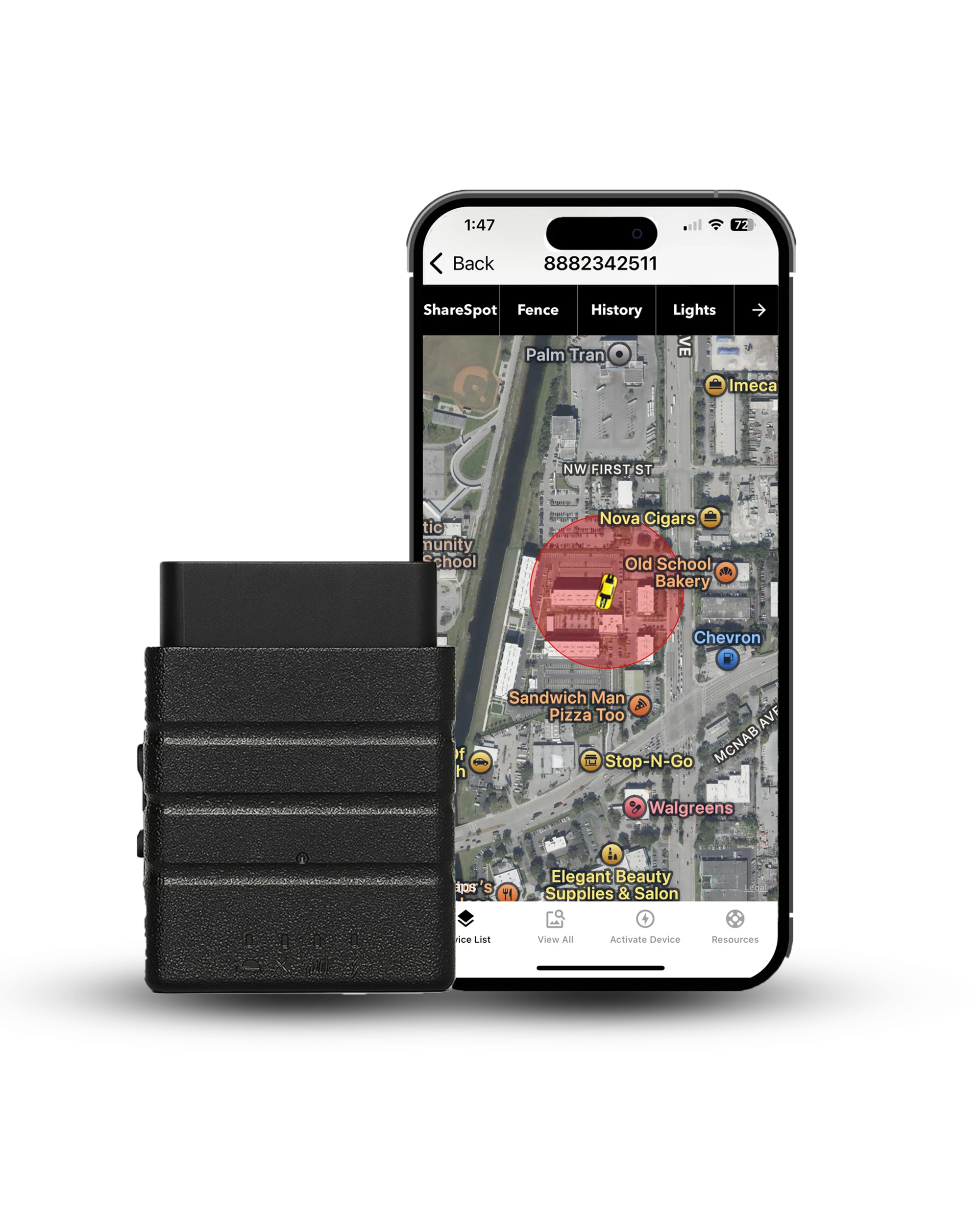
For a company vehicle, the practical setup is a plug-in tracker that reports location and trip history without needing anything wired or charged. Konnect plugs into the OBD2 port and updates every 3 seconds.
See the Konnect OBD2 TrackerReal-World Scenarios: Legal vs Illegal Tracking

Below are common situations and how Canadian law generally views them. Every situation is different, so treat these as a starting point rather than a ruling on your specific case.
| Scenario | Generally | Why |
|---|---|---|
| You track your own car to prevent theft | Legal | You own the vehicle, so you're free to protect it. |
| You track company trucks during work hours | Legal | A legitimate business use, provided employees are informed and tracking happens on the clock. |
| You track a co-owned car with mutual agreement | Legal | Both owners have consented, so the law recognizes it as fair use. |
| You track employees after work hours | Risky | Monitoring beyond a shift invades personal privacy and is a common route to a dispute. |
| You use location data to discipline a driver without telling them | Risky | The Privacy Commissioner of Canada flagged this in a real case. Drivers need to know about every way you use the data. |
Penalties & Risks of Illegal Tracking
When tracking crosses the line, trouble can come from three places: criminal law, privacy law, and the civil courts. The table below shows how they compare.

| Law | What it covers | Top penalty or result |
|---|---|---|
| Criminal Code s. 430, mischief | Getting in the way of someone's use of their property | Up to 10 years in prison if the property is worth over $5,000. Up to 2 years if it is under $5,000. |
| Criminal Code s. 264, criminal harassment | Repeated following or watching that makes someone fear for their safety | Up to 10 years in prison |
| Civil lawsuit | Invasion of privacy or emotional distress | A court can order money damages. In Ontario's Jones v. Tsige case, the court set a range of up to $20,000 for snooping without proof of money loss. |
| Privacy Commissioner of Canada (PIPEDA) | Businesses that track people without being open | An investigation and findings, plus recommendations to fix the problem |
On top of all that, the damage to your name with customers and employees can take years to fix.
A real case shows how this plays out. In PIPEDA Case #2006-351, a telecommunications company used GPS tracking in its service trucks to improve dispatching. Employees complained after learning the same data was also being used to evaluate their individual performance. The Privacy Commissioner's office found that GPS tracking for safety and dispatching was an acceptable use with implied consent, but that using the same data to routinely evaluate individual employees needed clearer disclosure. The company agreed to develop a written policy on how the data could be used for employee management and to train its managers on that policy, and the matter was resolved.
The lesson holds up twenty years later. The tracking itself was fine. The undisclosed second use of the data was the problem.
In my experience, the legal trouble almost never starts with the tracker. The trouble starts with a surprise, like a driver who finds out about the device later, or data that gets used for something nobody mentioned.
What to Do If You Find a Tracker on Your Car
Finding a device you didn't put there feels awful. Take a breath. The steps below keep you safe and protect any evidence. AirTags and similar tags can also set off an alert on your phone, so check for that too.
- If you feel unsafe, go somewhere safe first, like a police station or a busy public place.
- Take photos of the device where it sits. Show how it is attached and any brand names or numbers on it.
- Call your local police and ask for a file number.
- Leave the device in place until police say it is okay to remove it, because it may be evidence.
- Write down the last time you used the car with no problem, and who else had access to it.
Need help finding hiding spots? Our guide on how to locate a GPS tracker on your car walks you through the usual places. For support, the Government of Canada keeps a directory of victim services at justice.gc.ca.
Can You Sue Someone Who Put a Tracker on Your Car?
Possibly. Canadian courts accept privacy lawsuits. In Ontario, the Court of Appeal's Jones v. Tsige decision lets people sue for "intrusion upon seclusion," which means someone snooped into your private life on purpose. B.C., Manitoba, Saskatchewan, and Newfoundland and Labrador also have Privacy Acts that allow lawsuits. A lawyer licensed in your province can tell you if your case is strong enough to bring.
How to Stay Compliant

Staying compliant with Canada's GPS tracking laws isn't complicated, and takes little more than a bit of structure and honesty. Follow these six steps and you'll stay well within the lines.
The Office of the Privacy Commissioner of Canada regularly investigates complaints tied to workplace monitoring, including GPS and vehicle tracking. Transparency is your best defense against ending up as one of them.
What to Look for in a Tracker for Canadian Use
Technology won't make you compliant on its own, but the right features make the job a lot easier. These are the ones worth checking before you buy, whichever device you end up with.
The Konnect OBD2 GPS Tracker covers the practical side of that list:
- Real-time location: Position updates every 3 seconds, so a stolen vehicle report carries an address rather than a description.
- Trip history: A full year of trip records, which is what makes an after-the-fact review possible at all.
- Geofence and speed alerts: Notifications when a vehicle leaves a defined area or exceeds a speed you set.
- Tamper alert: Fires the moment the tracker is unplugged from the OBD2 port.
- No wiring or charging: Plugs into the port under the dash in about ten seconds and draws power from the vehicle.
Konnect's features can support your compliance work, but the legal responsibility for getting consent and following the law is still yours. The tracker doesn't do that part for you.
Final Thoughts: Staying Smart and Legal with GPS Tracking in Canada
GPS tracking can be an incredible tool for safety and accountability, but only when you use it the right way. Canada's privacy laws aren't here to stop you from protecting your property or managing your business. They're meant to keep tracking ethical, transparent, and fair.
So whether you're installing an OBD2 GPS tracker to monitor your fleet, recover a stolen vehicle, or check in on a family car, always follow one rule: get consent and stay transparent.
When you do that, GPS tracking becomes more than just legal, and turns into a smart layer of protection for you, your drivers, and your business.
This guide is general information, not legal advice
Everything on this page reflects a general understanding of Canadian GPS tracking law as of October 2026 and is not a substitute for advice from a licensed lawyer. Privacy law in Canada changes at both the federal and provincial level, and how these rules apply can depend heavily on your specific situation.
If you're making a decision with real legal stakes, such as installing a tracker on a vehicle you don't fully own, monitoring employees, or anything involving another person's consent, talk to a lawyer licensed in your province first.

Ready to track your own vehicle or fleet?
The Konnect OBD2 GPS Tracker plugs in under the dash in about ten seconds, updates every 3 seconds, and never needs charging. $39.95 with an $8.95 unlimited plan, or $199 once with no monthly fee at all.
About the Author

 Buy on Amazon