
Homemade GPS Jammer: Why You Shouldn't Build One (and What to Do Instead)
-
01
GPS jammers are illegal to sell, own or use in the US, with fines that can reach into six figures
-
02
A jammer floods a wide radius, so it never blocks only one device
-
03
Jamming blocks a signal while spoofing fakes one, and the two are handled differently
-
04
Real cases show jammers disrupting airports and being linked to a fatal crash
-
05
Unwanted tracking has legal remedies that don't put an aircraft at risk
If you've searched for how to build a GPS jammer, you were almost certainly trying to solve a real problem: an employer watching your every move, a feeling that someone is tracking your car, a general unease about being followed. Those are legitimate worries. A jammer is not the answer to any of them, and this article explains why in plain terms: what these devices are, how they actually work, why they're illegal in the United States, and what the safer options are.
I'm Ryan Horban, and I've spent 15+ years working with GPS tracking hardware. That experience is exactly why I won't publish a build guide for a jammer, and why the rest of this page is about understanding the device rather than making one.
The short version: a homemade GPS jammer is illegal to build, sell, or use anywhere in the United States, and because it can't be aimed at just one device, it knocks out GPS for every driver, phone, and aircraft nearby, not just the one you're trying to avoid. If you're worried about being tracked, the fix is finding and removing the tracker, not jamming every GPS signal within 50 feet of your car.
On this page
What Is a GPS Jammer?
The definition
A GPS jammer is a small transmitter that broadcasts radio noise on the same frequency the GPS satellites use. A nearby receiver can no longer pick the faint satellite signal out of that noise, so it loses its position fix. The jammer doesn't hide one device, it drowns out the frequency for everything in range.
That last point is the one people miss. GPS satellite signals are extraordinarily weak by the time they reach the ground, roughly the strength of a car headlight seen from thousands of miles away. Very little transmitted noise is needed to bury them, which is why cheap jammers work at all, and also why they can't be aimed. A device sold as a personal privacy gadget for one car will knock out every GPS receiver around it: other vehicles, phones, and anything nearby that depends on the signal.
Are GPS Blockers, Scramblers, and Jammers the Same Thing?
Yes. A GPS blocker, a GPS signal blocker, and a so-called GPS scrambler are all names for the exact same device: a small transmitter that drowns out GPS signals with noise. Sellers use softer-sounding names to make the product feel less serious, but the FCC treats a "blocker" exactly the same as a "jammer." Same law, same fines, same risk.
The same goes for a car GPS jammer or a GPS jamming device. Whether it plugs into your cigarette lighter, sits in your glove box, or gets wired into your dash, it's still a jammer under federal law. There's no smaller, safer, or more "legal" version, no matter what the listing calls it.
Related readingDoes aluminum foil actually block GPS signal?How a GPS Jammer Works
To see where the harm comes from, it helps to follow the sequence. A legitimate tracker and a jammer are working on the same tiny slice of radio spectrum, which is the whole problem.
The jammer's noise is far stronger up close than the real satellite signal ever is, so the receiver locks onto the noise and loses its fix.
Types of GPS Jammers
Jammers aren't all the same size or strength. Here's how the common ones break down.
| Type | What it means for range |
|---|---|
| Small portable unit | Runs on a battery, effective for a few feet, easy to hide in a bag or glove box. |
| Plug-in car unit | Draws power from the vehicle's 12-volt outlet, the most common type found in cars, effective for roughly 15 to 30 feet. |
| Hard-wired unit | Wired straight into the vehicle's power, can cover a wider area and sometimes hits cellular or Wi-Fi signals too. |
| High-power unit | Needs a stronger external power source, covers a much bigger area. This tier is restricted to military and government use. |
The size and power change, but the law doesn't. Every one of these is illegal for a private citizen to build, sell, or run in the US.
Jamming Against Spoofing: Not the Same Thing
These two terms get used interchangeably, but they're different attacks with different consequences, and it's worth knowing which is which.
| GPS jamming | GPS spoofing |
|---|---|
| Broadcasts noise on the GPS frequency so the receiver hears nothing usable and loses its fix entirely. | Broadcasts a counterfeit satellite signal so the receiver calculates a false position and believes it. |
| The map goes blank or freezes. You know something is wrong. | The map looks normal but is lying. You may not know until it matters. |
Jamming is the blunter tool and the one people build or buy to dodge tracking. Spoofing is more sophisticated and shows up more often in military and state-level electronic warfare. Both are illegal for civilians in the US, and both put anything relying on GPS nearby at risk.
Why GPS Jammers Are Illegal in the US
Jamming any radio communication has been against federal law since the Communications Act of 1934. According to the FCC, it is illegal to import, manufacture, market, sell, or operate any kind of signal jammer in the United States, and there's no license or exception for consumers or businesses. Penalties can run past $100,000 per violation, plus equipment seizure and, in serious cases, criminal charges. In 2016 the FCC hit one manufacturer with a $34.9 million fine for marketing 285 different jammer models to US customers.
The reason the law is that strict comes down to the point made earlier: a jammer cannot be contained to one vehicle. The same weak-signal physics that lets a cheap device work at all guarantees it spills over onto everyone nearby. When the thing it spills onto is aviation or emergency services, a private attempt at privacy becomes a public-safety event.
A trucker who got caught jamming near Newark Airport
The most-cited example is Gary Bojczak, a New Jersey contractor who ran a jammer in his work truck so his employer couldn't track him. Driving past Newark Liberty International Airport, his jammer knocked out a new aircraft navigation system the airport was testing. FCC investigators traced the interference straight to his truck, and Bojczak handed the device over on the spot.
In 2013 the FCC proposed a $31,875 fine. Three years later, after Bojczak showed he couldn't afford it, the FCC settled for $2,360, paid in four installments, as long as he stayed jammer-free for three years. Even at the reduced amount, one guy hiding from his boss ended up dealing with a federal investigation over an airport's navigation system.
Source: FCC Consent Decree DA 16-184, fcc.gov
Four killed when a medevac plane lost GPS near White Sands
The stakes get much higher than a fine. On May 14, 2026, a Beechcraft King Air air ambulance crashed into New Mexico's Capitan Mountains, killing both pilots and two flight nurses. As AOPA reported in June 2026, the NTSB's preliminary report confirms that scheduled military GPS jamming from White Sands Missile Range was active during the flight.
Shortly after taking off from Roswell to pick up a patient, the crew lost GPS and told air traffic control. Controllers got the military to pause the jamming, the GPS came back, and the crew reported the airport in sight and took a visual approach. The jamming resumed a few minutes later, and the aircraft struck a ridge in the dark. A weather station at the destination airport was also out of service that night. The NTSB hasn't named a cause yet, and a final report is still months away.
That second case was authorized military testing, not a consumer device, and that distinction matters. But the physics is identical. A jammer removes GPS for everyone in range, and you do not control who is in range or what they are doing when the signal drops. Reports of GPS interference in US airspace have climbed from a handful a year to dozens as the technology spreads, according to the Aircraft Owners and Pilots Association.
A jammer doesn't give you privacy, it gives everyone around you a blackout. You cannot buy your own peace of mind with a device whose whole method is taking the signal away from strangers who never agreed to it.
Who Actually Uses Jammers, and Why It Backfires
Setting the military aside, the civilian users tend to fall into a few groups, and none of them come out ahead:
- Employees dodging fleet tracking: the single most common reason, and the one behind the Newark case. This ends careers and draws federal fines rather than solving a workplace dispute.
- Car thieves: jammers are used to defeat a stolen vehicle's tracker, which is why a straight-line gap on a theft-recovery map gets treated as a red flag, not a dead battery. Good trackers now flag jamming instead of just going quiet.
- People who feel watched: someone worried about a tracker on their own car reaches for a jammer, not realizing they've swapped a private worry for a federal offense that also knocks out their own phone.
There's a technical irony in the first two. Quality fleet and tracking platforms now treat a sudden, total loss of GPS as a red flag in itself. On many systems a jammed trip shows up as a straight line on the map from the moment the signal dies to the moment it returns, which is an obvious tell rather than a clean disappearance. The device keeps reporting other data too. Jamming doesn't make someone invisible, it makes them conspicuous.
Can a GPS Tracker Be Jammed?
Yes, and it's easier than most tracker owners think. A tracker and a jammer use the same tiny slice of radio spectrum, so a $30 jammer sitting a few feet away can blank out a professional-grade tracker just as easily as a phone's GPS.
The good news is that jamming leaves clues. Here's what to watch for:
- A sudden, total signal drop. Normal signal loss, like tunnels or parking garages, fades in and out. Jamming usually cuts the signal instantly, like a switch being flipped.
- A straight line on the map. Many tracking platforms draw a straight line from the last known point to wherever the signal comes back, since there's no data in between. A real drive never looks like that.
- The same gap, over and over. If a vehicle loses signal at the same time of day, on the same route, or with the same driver, that points to something deliberate, not bad luck.
- GPS and cell signal dropping together. Some jammers hit more than one frequency at once. Losing GPS and phone signal in the exact same spot is a bigger red flag than losing GPS alone.
Before you assume the worst, rule out the boring explanations first: a loose OBD2 connection, a dead battery, or bad reception at that spot on the route. Our guide on why an OBD GPS tracker stops updating walks through those everyday fixes before you jump to jamming as the cause.
What Actually Blocks GPS Signal?
Not everything that gets in GPS's way is illegal. There's a real difference between something that happens to block the signal and a device built to jam it on purpose.
- Thick metal and concrete. Parking garages, tunnels, and steel shipping containers block GPS the same way they block a phone call, just by being in the way. No transmitter involved.
- A sealed metal container. Wrapping something in foil or putting it in a metal box can weaken or stop the signal, since metal reflects radio waves. It's passive. Nothing is being broadcast.
- Tall buildings and dense trees. Both scatter and weaken the signal enough to throw off accuracy, especially in a city.
A jammer is different because it's active. It doesn't just sit there getting in the way, it broadcasts noise on purpose to drown the signal out, and that's the part the law cares about. If you think a tracker got placed on your car without your knowledge, the next section covers what to actually do about it, legally.
What to Do Instead
Every legitimate reason someone reaches for a jammer has a lawful path that actually works.
If you think there's a tracker on your car
Don't jam, because that's illegal and tips off nothing useful. If the vehicle is yours, a physical search of the common spots (wheel wells, under bumpers, inside the OBD2 port under the dash) or a professional sweep will find a device.
Our guide on how to locate a GPS tracker on your car walks through exactly where to check first. If you find one you didn't place and you didn't consent to, that's a matter for law enforcement. Before you remove it, though, check whether removing a GPS tracker is legal where you live, since it depends on who owns the vehicle and, in many states, covert tracking of a vehicle you own is itself a crime.
If your employer's tracking feels invasive
This is a policy and legal question, not a radio one. Several states, California included, require written notice before an employer tracks a vehicle. See our guide to California's GPS tracking laws for what's required there, and check with an employment attorney if you're not sure your state is covered. That route protects your job. A jammer ends it and adds a fine.
If you want control over your own vehicle's location
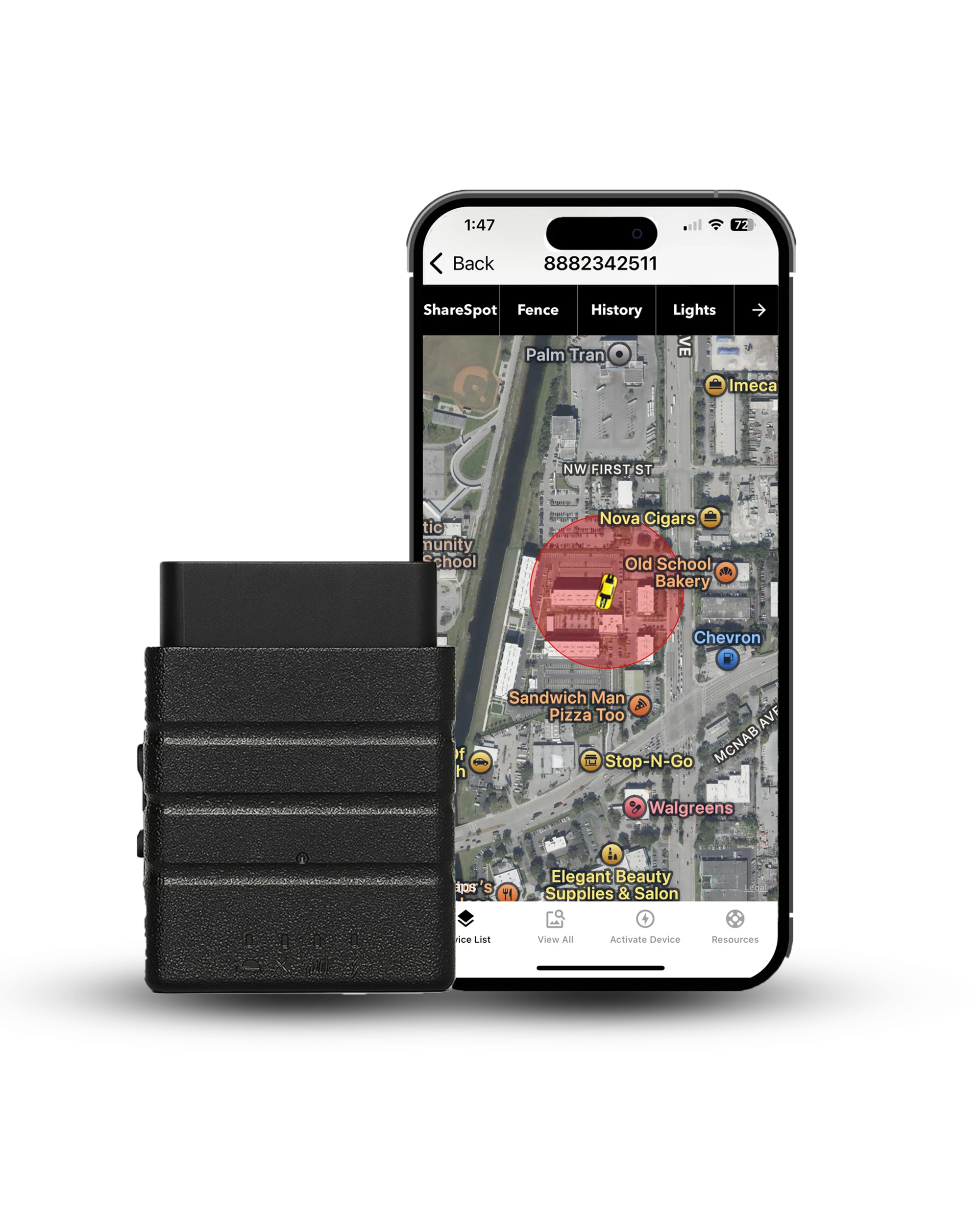
The honest version of what a jammer promises, privacy and control, comes from owning the tracking, not blocking it. A tracker on a car you own, that you control the data for, tells you when the vehicle moves, where it goes, and whether anyone else is interfering with it. That's the legal inverse of a jammer, and it's what Konnect is built for.
Related readingGPS tracking laws in the USA, explainedThe bottom line on jammers
Building, importing, marketing, selling, or using a GPS jammer is a federal offense in the United States, with no consumer exception. Beyond the legal risk, a jammer can't be limited to your own vehicle, so it puts other drivers, emergency responders, and aircraft at risk every time it's switched on.
This article is informational and is not legal advice. If you're dealing with unwanted tracking or a workplace monitoring dispute, talk to an attorney or your local law enforcement rather than reaching for a device that trades a private problem for a public danger.
The Legitimate Alternative: Track What You Own
If your goal was ever control over a vehicle's location, do it the lawful way, with a tracker on a car you own and consent to monitor. The Konnect OBD2 tracker plugs into the port under the dash, reports position every 3 seconds, and alerts you if someone tampers with or unplugs it. That is the exact opposite of a jammer: it gives you the signal instead of taking it from everyone around you.
Real-time tracking, done the legal way
Konnect plugs into the OBD2 port in under a minute, updates every 3 seconds, and sends speed, geofence and tamper alerts straight to your phone, with no contract. It's on sale now at $39.95.
Get the Konnect OBD2 TrackerAbout the Author

 Buy on Amazon