
The Complete History of OBD-II: How Cars Learned to Talk
-
01
OBD2 became standard in 1996 to unify vehicle diagnostics across manufacturers
-
02
The 16-pin port provides access to real-time vehicle data and engine systems
-
03
OBD data enables predictive maintenance by identifying issues early
-
04
OBD GPS trackers combine location tracking with vehicle diagnostics
-
05
Wireless diagnostics and cloud monitoring are the next step, but not a standard yet
As an Amazon Associate, Konnect GPS earns from qualifying purchases.
The Complete History of On-Board Diagnostics (OBD and OBD-II): How Cars Learned to Talk
Ever wondered how your mechanic instantly knows what that check engine light means? Behind that tiny symbol lies decades of innovation: the story of OBD-II, or onboard diagnostics.
What began as crude emission-control monitoring in the 1960s has evolved into the OBD-II diagnostic systems that power today's vehicle health, fleet tracking, and predictive maintenance tools. Since 1996, every car and light truck sold in the United States has carried an OBD2 diagnostic port, a universal gateway connecting the engine control unit (ECU) to scan tools, data loggers, and the vehicle telematics platforms fleet managers rely on worldwide.
In this article, you'll discover the complete history of OBD and OBD-II, how it started, how it became a global standard, and what it means for the future of vehicle diagnostics and driver safety.
Before we dive into its evolution, let's start with the basics: what exactly is OBD, and why is it the foundation of every vehicle diagnostic system on the road today?
What Is OBD (On-Board Diagnostics)?
On-Board Diagnostics (OBD) is a standardized vehicle system that monitors and reports issues in the engine, powertrain, and emission control systems using sensors and an engine control unit (ECU), which generates diagnostic trouble codes (DTCs) for quick repairs.

At its core, OBD uses an onboard computer working with multiple sensors, such as oxygen sensors and engine control modules, to continuously monitor the vehicle's performance. When something goes wrong, the system generates a Diagnostic Trouble Code and triggers the check engine light on your dashboard.
Freeze-frame data: the snapshot your car saves at the exact moment a fault code is set, capturing engine RPM, vehicle speed, fuel trim, and sensor readings. Without it you know what broke; with it you know what the engine was doing when it broke.
Technicians and fleet managers retrieve this data using scan tools, handheld scanners, or current OBD2 readers and data loggers for deeper vehicle diagnostics and fleet maintenance insights.
Today's OBD systems follow strict international standards set by:
-
Society of Automotive Engineers (SAE)
SAE J1962, SAE J1979, and SAE J1850 define the connector, the diagnostic services, and the older signaling protocols.
-
International Organization for Standardization (ISO)
ISO 15765-4 governs the controller area network (CAN) that carries diagnostic traffic in every current vehicle.
Together, these protocols form a unified diagnostic language that keeps vehicle manufacturers, technicians, and fleet operators aligned across the globe.
Before OBD became the global standard we rely on today, it went through decades of trial, innovation, and regulation. Let's rewind to the early years of vehicle diagnostics to see where it all began.
The Early Years (1960s to 1970s): When Cars First Learned to Talk
Alright, let's rewind the clock, back when cars were all muscle and zero brains.
The story of onboard diagnostics actually starts with something far less glamorous than horsepower: emission controls. Yeah, the stuff that keeps the air clean.
Volkswagen: The First Car That Whispered Back (1968)
In 1968, Volkswagen quietly made automotive history by fitting its cars with a tiny onboard computer that could spot basic faults in the emission control system. Nothing fancy, just a simple something's-off alert.
But that was a glimpse into the future: cars that could monitor their own health.
Let's be honest, early OBD systems were chaos on wheels. Like toddlers trying to speak, each one babbling in its own language. Mechanics had to play translator, juggling weird connectors, mystery codes, and proprietary tools just to get a single reading. But beneath that chaos, the science was brilliant.
Automotive engineers were learning to digitize mechanical feedback, one signal at a time. That messy start sparked a revolution: cars that could finally tell us what's wrong before we even picked up a wrench.
Fast-Forward to 1978: Datsun Joins the Conversation

A decade later, Datsun decided it was time to teach its cars to talk, too. The result was a homegrown diagnostic system that could detect simple issues, though still speaking its own dialect.
These early setups were like a crowded room full of toddlers: a few words, lots of noise, and no one really understanding each other. Every vehicle manufacturer had its own connectors, signaling protocols, and fault codes.
Mechanics basically needed a library of scan tools just to survive a day in the shop. Not exactly efficient, but it was progress.
The California Air Resources Board (CARB): The Game Changer
Then came the grown-ups. The California Air Resources Board stepped in with a simple demand: enough confusion, make this universal.
CARB saw that emission testing without consistency was chaos. So their early compliance programs forced automakers to start thinking about standardized diagnostics. That regulatory nudge would soon spark the first real movement toward a shared diagnostic language.
That was the birth of the OBD-I standard, and the foundation for every OBD-II system we use today.

By the early '80s, cars could talk, but none spoke the same language. That was like a garage full of diplomats with no translators. So engineers wrote a new rulebook to end the chaos: OBD-I. In the next section, we'll see how it changed everything.
OBD-I Era (Late 1970s to Early 1990s): The First Attempt at Standardization
By the 1980s, automotive engineers finally decided it was time to get their act together. The dream was a world where every car could speak the same diagnostic language. The reality? Well, not quite yet.
The first generation of On-Board Diagnostics, now called OBD-I, was a bold start but far from perfect. Each vehicle manufacturer built its own connectors, signaling protocols, and fault code systems. Mechanics were stuck buying brand-specific scan tools just to decode what a single car was trying to say.
Diagnostic data was barely a whisper. You'd get a few binary trouble codes, maybe a flickering check engine light, and that was it. No real-time data, no freeze-frame snapshots, and definitely no standardized diagnostic connector.
Let's just say, OBD-I was like giving cars walkie-talkies when they really needed smartphones.

Why It Fell Short
- No universal data link connectorEvery carmaker used its own plug and pins.
- Data stream was basic at bestNo real-time readings to work with.
- No freeze-frame dataYou couldn't see what the engine was doing when the fault hit.
- Brand-specific scan tools onlyMechanics needed a different one for every logo in the garage.
OBD-I proved that self-diagnostics could work, but it also exposed a global headache. The world needed a unified diagnostic protocol that every car, tool, and technician could understand.
That's when OBD-II roared onto the scene and changed everything.
The Leap: OBD-II and Global Standardization (1990s to 2000s)
By the early '90s, regulators had one clear message for automakers: enough freelancing, play by the same rules.
The Clean Air Act of 1990 and CARB's stricter emission standards officially put their foot down. Every vehicle sold in the U.S. from model year 1996 onward had to come equipped with a standardized onboard diagnostics system, what we now know as OBD-II.
That was a complete reset of how cars communicated, got repaired, and even proved their emission compliance, not just a software update.

Key Milestones That Shaped OBD-II
- 1968Volkswagen fits a simple onboard computer that can flag basic emission-control faults.
- 1978Datsun adds its own diagnostic system, speaking its own dialect like everyone else.
- Early 1980sCARB pushes automakers toward consistency, laying the groundwork for OBD-I.
- 1991 to 1995OBD-II development led by SAE and ISO working groups, the engineers' version of peace talks.
- 1996OBD-II becomes mandatory in all U.S. light-duty vehicles, and chaos finally gets a rulebook.
- 2001Europe follows with EOBD for petrol cars, with diesel joining in 2004.
- 2013+India enforces OBD-II for all new vehicles under BS-IV and later BS-VI emission norms.
What Made OBD-II a Game Changer
Early OBD systems were like old-school landlines: limited, isolated, and painfully slow. OBD-II was the smartphone upgrade, fast and global and standardized. Here's why it mattered.
-
Universal Connector (SAE J1962)
One 16-pin port to rule them all. Finally, mechanics could use a single plug for any car.
-
Unified Signaling Protocols
From SAE J1850 VPW/PWM to ISO 9141-2, ISO 14230 (KWP2000), and CAN (ISO 15765-4), every car spoke the same technical language.
-
Standardized Fault Codes (DTCs)
Clear code families like P0xxx for powertrain, B0xxx for body, C0xxx for chassis, and U0xxx for network gave mechanics precise insights instead of guesswork.
-
Rich Data Stream
Real-time OBD2 data gives RPM, coolant temperature, oxygen sensor readings, fuel trim, vehicle speed, and more, which brought diagnostics to life.
-
Scan Tool Access
Any certified scan tool or OBD2 reader could now read faults and performance data from any vehicle.
-
Emission Compliance Built In
OBD-II wasn't just for repairs. It actively monitored emission control systems, storing data in the engine control unit for regulators and technicians alike.
Why It Changed Everything
For the first time in automotive history, diagnostics became universal. No more guessing games, no brand-specific codes, no expensive tool hoarding. Mechanics, fleet managers, and even DIY enthusiasts could finally plug in, decode, and act instantly.
OBD-I vs. OBD-II: How the Industry Finally Grew Up

| OBD-I Feature | Limitation | OBD-II Solution |
|---|---|---|
| Proprietary connectors | Incompatible tools | Universal 16-pin SAE J1962 port |
| Basic fault detection | No detail on cause | DTCs plus freeze-frame data |
| Minimal sensors | Weak emission accuracy | Advanced oxygen sensors |
| Regional standards | Poor compliance | Global OBD2 standard |
Global Expansion: EOBD, JOBD, and India's Leap Forward
Once OBD-II took off in the U.S., the rest of the world took the idea and gave it a local spin.
Governments everywhere realized that having a standardized diagnostic system wasn't just about cleaner air. Standardization meant safer vehicles, easier compliance, and smarter maintenance. So one by one, countries started joining the OBD revolution.
When the World Got Plugged In
Here's how the rest of the world joined the movement, each region adopting its own version of OBD while keeping the same universal heartbeat.
| Region | Standard | Year | Key Notes |
|---|---|---|---|
| United States | OBD-II | 1996 | CARB and EPA mandate that set the global benchmark. |
| Europe | EOBD | 2001 petrol / 2004 diesel | Defined under EU Directive 98/69/EC, and nearly identical to OBD-II. |
| Japan | JOBD | 2003 | Adapted for Asian vehicle architectures and local driving conditions. |
| Australia | ADR 79/01 | 2006 | Modeled after EOBD with added fuel-efficiency monitoring. |
| India | OBD-II / BS-VI | 2013 / 2020 | Mandatory for new vehicles under Bharat Stage VI emission norms. |
How Global Standardization Changed the Game

What this global rollout really did was bring order and harmony to what used to be diagnostic chaos.
Now, whether a fleet manager in California plugs into a truck or a technician in Mumbai scans a BS-VI car, both speak the same diagnostic language. That harmonization under the International Organization for Standardization created a truly global OBD ecosystem.
One that lets fleet tracking systems, GPS trackers, and compliance platforms work seamlessly anywhere in the world.
That's the reason your data logger or OBD2 reader doesn't freak out just because the car was made in Japan or Europe, and a quiet win for engineers and anyone who's ever had to troubleshoot an engine light halfway across the globe.
The OBD2 port is the one place in a car where location data and engine data come off the same plug. That is the whole reason an OBD tracker tells you more than a battery-powered puck stuck under a bumper.
Inside the Tech: Connectors, Protocols, and Data Links
At the heart of every OBD-II system lies its unsung hero, the diagnostic connector. That small 16-pin trapezoid tucked under your steering column is the gateway to your car's brain. Yeah, that port.
How It Works
Each pin in that connector carries its own mission. Some deliver power, some handle ground, and others act as the chat lines for the Controller Area Network (CAN).
Through it, your car's control modules, the ECU, TCU, ABS, and even your airbag system all gossip constantly, exchanging data in milliseconds. The connector itself follows the SAE J1962 standard, which defines its shape, pin layout, and voltage behavior.
Think of it as a perfectly organized 16-lane highway for digital traffic, with no wrong turns allowed.

Key Signaling Protocols: The Languages Cars Speak
Not all cars talk the same way, but OBD-II made sure everyone at least used the same alphabet. Here are the major signaling protocols you'll find under the hood.
-
SAE J1850 (VPW/PWM)
The dialect of classic GM and Ford systems.
-
ISO 9141-2 / ISO 14230 (KWP2000)
Common in Asian and European models. Smooth talkers, but a bit old-school.
-
ISO 15765-4 (CAN)
The default today: fast, reliable, and used by pretty much every vehicle since 2008.
Each protocol defines how data travels, from fault codes and vehicle identification numbers to real-time sensor data.
Where the Data Comes to Life
Technicians, engineers, and fleet managers tap into this port using scan tools, OBD2 readers, or data loggers to extract everything from OBD2 data streams to compliance reports.
That one connection unlocks your car's entire personality: diagnostic information, emission status, vehicle tracking data, and even predictive maintenance insights.
So next time you spot that little port under the dash, remember that it's a direct line to your car's story, not only a connector.
From Data to Insights: How OBD Powers Diagnostics Today
When OBD-II switched from simple codes to live data streams, vehicle diagnostics flipped on their head, turning guesswork into precision. Suddenly, fleet managers didn't have to wait for something to break before acting. The data itself became the warning light.

The New Age of Smart Diagnostics
Today, data loggers and OBD2 readers feed a continuous stream of engine control, vehicle speed, and sensor data directly into fleet tracking platforms. That means you can spot a failing oxygen sensor or rough idle before it turns into a tow truck moment.
Predictive maintenance algorithms take this a step further. They analyze those OBD2 data streams to flag unusual patterns, helping prevent costly breakdowns and keeping vehicles compliant with emission standards.
More Than Maintenance: A Connected Ecosystem
But the real story is that OBD has outgrown the garage. Its data now fuels:
- Insurance telematicsMeasures driver behavior and rewards safer habits.
- Asset tracking systemsSmarter logistics and fewer missing vehicles.
- Compliance managementHelps fleets stay ahead of regulatory audits.
And because everything is tied to that same OBD2 diagnostic port, it's all unified no matter where your vehicles operate.
The Bottom Line
What started as a way to monitor emissions has evolved into a full-blown intelligence network for transportation. From driver safety to fleet optimization, OBD-II is reporting problems and preventing them as well. The humble diagnostics port under your dashboard quietly became one of the most powerful tools in the automotive world.
So, why does OBD still matter? Simple. This is about keeping vehicles smarter, safer, and running longer, not just about fixing cars.
Why OBD Still Matters Today
You'd think after almost 30 years, OBD-II would be old news, but the standard is still the quiet genius behind everything from emission control to GPS-powered fleet tracking.

Here's why it still matters:
-
For everyday drivers
Your shortcut to quick answers, lower repair costs, and fewer check-engine meltdowns.
-
For fleet managers
The heartbeat of fleet safety, emission compliance, and predictive maintenance, all in one plug.
-
For GPS tracking systems
OBD data adds real-time insights, speed, fuel trim, and engine health that turn trackers into fleet intelligence tools.
-
For automotive engineers
The foundation of vehicle diagnostics as we know them, showing how cars think, communicate, and evolve.
-
For today's vehicles
OBD keeps control modules, sensors, and ECUs in sync, enabling fast fixes, fewer breakdowns, and safer roads.
In short, that tiny OBD2 port under your dashboard is the nervous system linking your car, your data, and your world on wheels.
But if you think OBD has peaked, think again. The next generation is already taking shape, and it's set to make diagnostics faster, wireless, and a whole lot smarter.
The Future: OBD-III, Remote Diagnostics and Cybersecurity
If you thought OBD-II was smart, buckle up. OBD-III is the idea of taking diagnostics from the garage to the cloud: real-time, wireless, always-on communication between your car, your mechanic, and, in the original proposal, the regulators.
Worth knowing before you read on: OBD-III is a concept, not a standard you can buy. CARB has studied remote OBD since the 1990s and tested roadside readers, but California has never adopted a mandatory remote OBD program, and the OBD-II regulation does not require manufacturers to fit wireless transmission. What actually exists today is telematics and aftermarket devices doing the same job voluntarily.
Picture This: The OBD Future in Motion
- Cloud-uploaded fault codesCars send DTCs straight to secure cloud networks.
- Instant fleet alertsManagers get notified through telematics dashboards with nothing to plug in.
- Live compliance monitoringEmission problems spotted before a vehicle ever fails an inspection.
None of that is science fiction. Whether the technology works has never been the open question.
Smarter Tech, Bigger Risks
But with all that connectivity comes the elephant in the server room: cybersecurity.
As OBD data travels wirelessly, the risks of data leaks, signal spoofing, or unauthorized access climb higher. The future is about protecting the data that powers faster, smarter diagnostics.
That means tougher encryption protocols, stronger compliance systems, and a sharper focus on data privacy for both individual drivers and entire fleets. Privacy is also the reason the original OBD-III proposal stalled: transmitting a VIN and fault codes to a regulator raises consent questions that were never fully settled.
Emerging Trends Driving the Next Chapter

Here's what's already rolling off the drawing board:
-
Integration with EV Powertrains
Battery health, charging cycles, and energy efficiency monitored in real time. Worth knowing: EVs are not required to support OBD2 at all, and most use manufacturer-specific protocols instead.
-
Over-the-Air Updates (OTA)
Cars self-updating their firmware the way your phone does.
-
Enhanced Data Logging
Continuous remote diagnostics for compliance management and predictive maintenance across fleets.
-
Unified Telematics Ecosystems
Merging GPS tracking, OBD, and IoT data into one live dashboard for total vehicle intelligence.
The Road Ahead
Over the next few years, remote diagnostics will redefine what it means to understand a vehicle, merging diagnostics, connectivity, and AI-driven prediction into one system.
Your car won't just tell you what's wrong. Your car will warn you before it happens, schedule its own fix, and keep the data secure while doing it.
Conclusion: From Blinking Lights to Data Intelligence
From the clunky onboard computers of the 1960s to today's cloud-connected diagnostics, the journey of onboard diagnostics is basically the story of how cars got smart and how drivers got smarter, too.
Every step forward, from OBD-I's early chaos to OBD-II's global standardization, brought us closer to vehicles that think, communicate, and adapt. What started as a simple tool to control emissions is now a full-blown intelligence network powering fleet GPS tracking, predictive maintenance, and driver safety across the world.
So, the next time that check engine light flickers on, don't roll your eyes. Listen. That tiny glow is your car speaking up, telling you exactly what it needs.
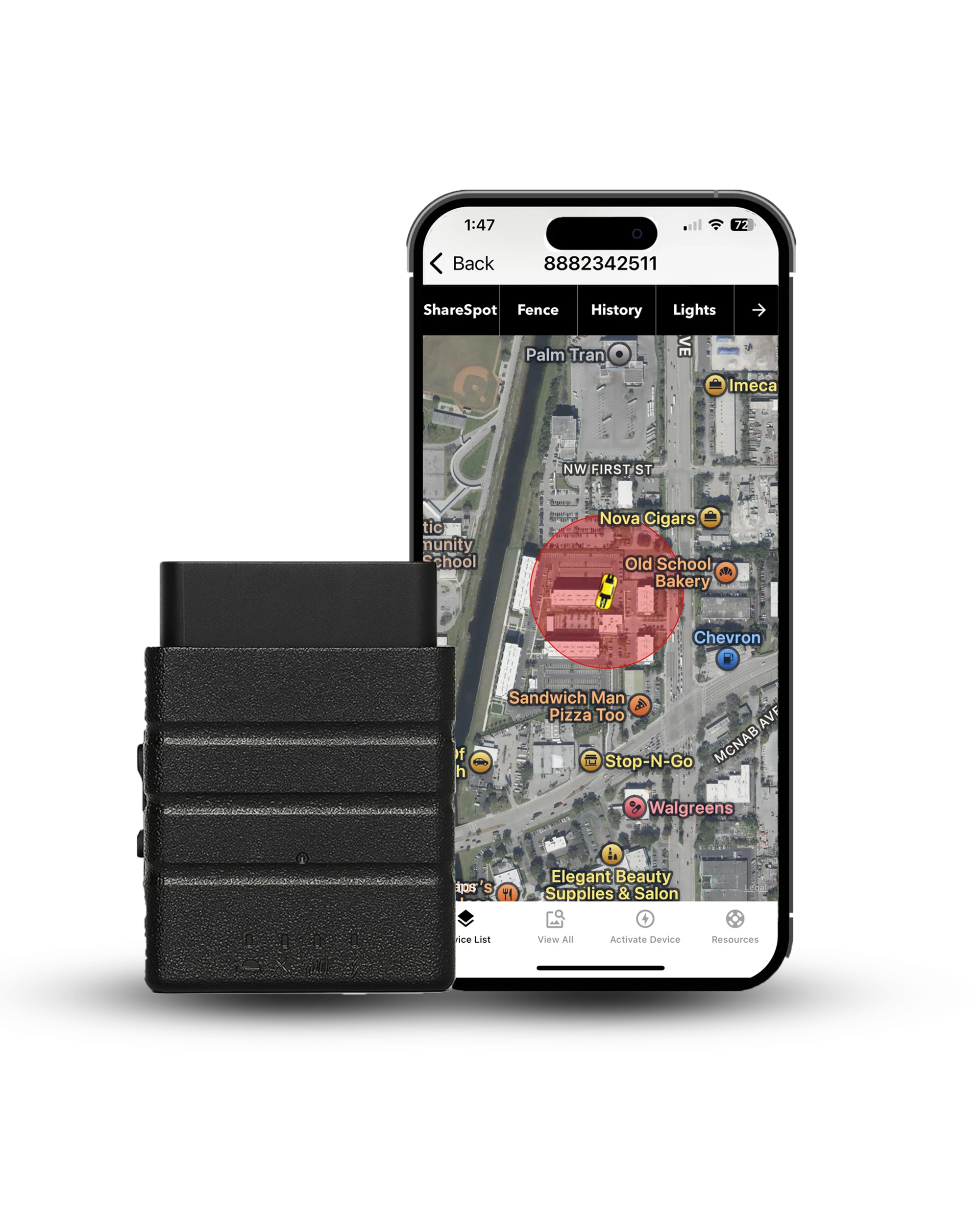
What That Port Looks Like With a Tracker In It
Here is the hardware side of everything above. This is our own Konnect OBD2 unit, photographed in house rather than pulled from a spec sheet.


Konnect OBD2 GPS Tracker
Take your car's smarts beyond the dashboard. Konnect uses the same 16-pin port this whole article is about, merging live diagnostics with real-time GPS tracking for $39.95 and $8.95 a month.
- 3-second updates
- Live engine data
- Unlimited data plan
- 1 year trip history
- Lifetime warranty
- USA-based support
- 150+ countries
- No contract
Put That Port to Work
OBD GPS tracking is the simplest way to merge real-time diagnostics with live location for sharper insights, safer drives, and total control.
About the Author

 Buy on Amazon