
Dog GPS Tracker
By: Ryan Horban
-
01
A microchip is identification, not location. Only a GPS collar tells you where your dog is right now
-
02
Nearly every real-time tracker needs a monthly subscription on top of the collar price
-
03
Battery claims assume power-saving mode, and live tracking drains it far faster
-
04
Geofence alerts matter more than raw accuracy, because they tell you the moment your dog leaves
-
05
Cellular coverage sets the limit, so check your area before buying for a rural home
As an Amazon Associate, Konnect GPS earns from qualifying purchases.
Dog GPS Tracker Collars: 5 Best For Your Furry Friend
Worried about your dog wandering off and getting lost? A GPS tracker for dogs can help keep your pet safe by letting you monitor their location in real time. This guide covers five of the best pet trackers available in the US, from location accuracy to health monitoring features.
By the end, you'll know:
Which tracker suits your dog
Whether an active escape artist or a laid-back senior needs a different device.
What the key features actually do
Geofencing, activity tracking and battery life, and which of them you'll use.
How they perform in different places
Dense woodland, a suburban yard and a rural property are not the same problem.
What each one really costs
The collar price plus the subscription, which is where the money actually goes.
A microchip is not a tracker
This trips up a lot of owners. A microchip carries an ID number that a vet or shelter can scan once somebody has already caught your dog. There is no battery in it, no GPS, and no way for it to tell you where your dog is. A GPS collar does the opposite: it reports a live position to your phone but does nothing once the battery dies. Most owners want both, for different moments.
Of dog owners had a dog go missing at least once over a five-year period, which works out at roughly one dog in seven.
Source: ASPCA lost pet survey
| Tracker | Best for | Subscription | Amazon rating |
|---|---|---|---|
| Pawfit 3 | All-round tracking with temperature alerts | From $4.75 a month | 4.1 from 1,289 ratings |
| PitPat | Activity and weight management, no location | None on the activity monitor | 4.1 from 1,892 ratings |
| Garmin TT 15X | Hunting and working dogs at long range | None, but needs a Garmin handheld | 4.7 from 18 ratings |
| Tractive LTE | Escape artists and everyday peace of mind | From about $5 a month | 4.0 from 26,755 ratings |
| Whistle Go Explore | Health monitoring and long battery life | $8.25 a month billed yearly | 3.8 from 3,748 ratings |
Ratings as of 1 July 2026. Prices and star ratings move constantly, so check before you buy.
1. Pawfit 3: Best All-Round Tracker
The Pawfit 3 is the most complete package on this list for a normal pet dog, which is a different job from tracking a hunting dog across nine miles of woodland. You get live location, geofencing, activity monitoring and a temperature alert, all of them handled adequately rather than any one of them brilliantly.
The temperature alert is the feature worth calling out, because nothing else here has it. If your dog is left somewhere hot or cold, the collar tells you, which matters more for a dog left in a yard or a car than most owners expect. The virtual fence works the same way: you draw a safe zone and get a notification the moment your dog crosses it, which is the alert that actually buys you time.
At 27 grams it's light enough that most dogs ignore it, and the strap is built to fit a range of collar widths rather than assuming one. If it comes off, you get an alert for that too, which is a thoughtful detail that several pricier trackers skip.
Key features
- Live location, updating every 5 seconds in live mode
- Live mode capped at 10 minutes to protect the battery
- Up to 10 geofence safety zones
- Temperature alerts for hot and cold conditions
- Activity monitoring
- Audio ID button and LED light with alarm
- 27 grams, waterproof, with a removal alert
- Family sharing with up to 10 people
Pros & cons
Pros
- Temperature alerts, which nothing else here offers
- Light enough at 27 grams that most dogs ignore it
- Alerts you if the device comes off the collar
- Cheapest subscription of the three live trackers here
Cons
- Needs cellular coverage, so weak in remote areas
- Not suitable for dogs under about 9 pounds
- The remote voice feature sounds muffled and can confuse a dog
- Subscription required for the tracking to work at all
What owners report
A five-star reviewer on Amazon praised the accuracy and the ability to set multiple zones across separate properties, and liked that it tracks exercise too. A one-star reviewer had the opposite experience: their dog escaped twice wearing a fully charged tracker, and the app returned a not-responding message both times, in an area they describe as having good coverage.
Subscription: from $4.75 a month. Manufacturer site: pawfit.com
2. PitPat: Best Activity Tracker
PitPat belongs on this list with an important caveat: the standard PitPat is an activity monitor, not a GPS tracker. The device pairs to your phone over Bluetooth and measures exercise, rest, distance and calories, and will not tell you where your dog is if they run off.
That's not a flaw so much as a different product. If what you actually want is to manage a dog's weight, understand how much exercise they're really getting, or keep an eye on a senior dog slowing down, PitPat does that job for around $39 with no subscription and a coin cell that lasts over a year. Compared with a tracker costing $100 plus $5 a month, that's a genuinely different proposition.
The app builds a profile for your dog including breed, age and weight, then sets activity goals against it and awards progress toward them. Setup takes about fifteen minutes, and shared access means a partner or a dog walker can see the same data.
Key features
- Daily exercise, rest, distance and calories burned
- Breed-specific goals and weight management advice
- CR2032 coin cell lasting over a year, user replaceable
- Around 30 grams, roughly 2.4 by 1.3 inches
- Waterproof, fits any collar or harness with a Velcro strap
- Shared access for a partner or dog walker
- iOS and Android app, no subscription
Pros & cons
Pros
- No subscription at all, unlike everything else here
- Over a year of battery on a replaceable coin cell
- Cheapest device on this list at around $39
- Genuinely useful for weight and fitness management
Cons
- No live location, so it will not find a lost dog
- Distance is estimated from stride length, so it needs calibrating
- No route map, only total distance covered
- A UK brand, so US coverage and support are worth checking first
What owners report
A five-star reviewer used it to measure how far an eleven-year-old Siberian Husky actually travels each day, and found an average of about eight miles, noting the app awards trophies for distance milestones and confirming it reports activity rather than location. A one-star reviewer in the US said it tracked nothing over several days and suspected it works better in the UK.
Price: around $39 with no subscription. Manufacturer site: pitpat.com
3. Garmin TT 15X: Best For Hunting And Working Dogs
The Garmin TT 15X is not really a pet tracker, and buying one for a suburban dog would be a mistake. This is a dog tracking and training collar for hunting, using its own radio link to a Garmin handheld rather than a cellular network, which is exactly why it works nine miles out where nothing on a phone network would.
That radio link is also the catch. The collar is useless on its own: it needs a compatible Garmin handheld such as an Alpha, PRO 550 Plus or Astro 430, and those cost considerably more than the collar. For a hunter who already owns one, this is the obvious addition. For anyone else, the total system cost puts it in a different category entirely.
The build reflects the use case. Up to 80 hours of battery, water resistance to 10 meters, LED beacon lights visible up to 100 yards for finding a dog in low light, and 18 levels of stimulation plus tone and vibration for training work. There's also a remote sleep function so you can shut the collar down between runs without taking it off.
Key features
- Tracking range up to 9 miles
- Up to 80 hours of battery life
- Remote sleep mode to conserve power
- GPS and GLONASS receiver, top mounted
- Water resistant to 10 meters
- LED beacon lights visible up to 100 yards
- 18 stimulation levels plus tone and vibration
- 7.3 oz transmitter, 10 oz with the collar
Pros & cons
Pros
- Works far beyond cellular coverage, up to 9 miles
- No monthly subscription of any kind
- Training functions built into the same collar
- Built for weather and rough terrain
Cons
- Useless without a compatible Garmin handheld
- Total system cost is far above every other option here
- At 10 oz with the collar, it's the heaviest on this list
- Sold on US radio frequencies, so it will not work in some countries
Price: collar sold separately from the required handheld. Manufacturer page: garmin.com
Of recovered dogs were found because of an ID tag or microchip. Nearly half were found the old-fashioned way, by the owner searching the neighborhood.
Source: ASPCA lost pet survey
4. Tractive LTE: Best For Escape Artists
Tractive is the default choice for most owners, and the rating count tells you why: more people have bought and reviewed this than everything else on the list put together. The device does one thing very well, which is telling you the moment your dog leaves a safe zone and then letting you follow them.
Live tracking refreshes roughly every 15 to 60 seconds, which is slower than the 5-second modes on some rivals but fast enough to follow a dog on foot. The escape alert is the part that matters most: you find out your dog is gone when they cross the boundary, not an hour later when you notice the yard is empty.
At 1.2 ounces it suits dogs from about eight pounds up, it's fully waterproof, and battery life runs around seven days, stretching closer to ten in power-saving mode when it's connected to home Wi-Fi. Activity and sleep monitoring are included, and they give a reasonable overview rather than clinical detail.
Key features
- Real-time tracking with no distance limit
- Live tracking refreshing every 15 to 60 seconds
- Escape alerts when your dog leaves a safe zone
- Activity and sleep monitoring with a wellness score
- 1.2 ounces, suits dogs from about 8 pounds
- Waterproof and shockproof
- 7 to 10 days of battery depending on mode
- Premium plan adds family sharing and location history
Pros & cons
Pros
- Escape alerts are the fastest warning on this list
- No distance limit, unlike the radio-based Garmin
- Light enough for small dogs from about 8 pounds
- By far the largest body of customer reviews to judge from
Cons
- Subscription required, from about $5 a month
- Refresh rate is slower than the 5-second live modes elsewhere
- Seven days of battery is short next to Whistle's twenty
- Needs a collar at least one inch wide
Subscription: from about $5 a month, with a 30-day money-back trial. Manufacturer site: tractive.com
5. Whistle Go Explore: Best Battery And Health Tracking
Whistle sits at the top of the price range here, around $100 for the device before the subscription, and earns it in two specific places: battery life and health monitoring. Twenty days on a charge is a different experience from recharging every week, particularly for camping or anywhere without easy power.
The health tracking is closer to a Fitbit than to the basic activity counters elsewhere on this list. The app watches for changes in scratching, licking, and eating and drinking, which are the behaviors that flag a developing problem before it becomes obvious. The app also gives you access to a veterinary team, which is genuinely useful when you've spotted something odd and it's Sunday evening.
Location comes from satellite plus AT&T's LTE-M network and maps in Google Maps, so accuracy in a busy park is good. The network is also the constraint: coverage depends on AT&T LTE-M where you live, which is worth checking before you commit. Whistle offers a 90-day risk-free trial, which makes that easier to test.
Key features
- Up to 20 days of battery on a charge
- Two-hour charge time with the fast charger
- Satellite plus AT&T LTE-M, mapped in Google Maps
- Health monitoring for scratching, licking, eating and drinking
- Access to a veterinary team through the app
- 24-hour location timeline
- IPX8 waterproof rating and an LED light
- No home base unit required
Pros & cons
Pros
- Twenty days of battery, the longest on this list
- Health monitoring that flags behavior changes, not just steps
- Veterinary access built into the app
- 90-day risk-free trial to test coverage where you live
Cons
- Around $100 for the device, roughly double a basic tracker
- Subscription on top at $8.25 a month billed yearly
- Tied to AT&T LTE-M coverage specifically
- The two-hour charge time needs the fast charger
Price: around $100 for the device, plus $8.25 a month billed yearly. Manufacturer site: whistle.com
Every one of these is a subscription in a plastic case. Work out the two-year cost before you fall in love with the feature list.
What Is A Dog GPS Tracking Device?
A dog GPS tracker is a small device that attaches to a collar and uses satellite positioning to work out where your dog is, then sends that position to your phone over a cellular network. Some models add Wi-Fi and Bluetooth positioning to fill the gaps where satellite reception is poor, such as dense woodland or between tall buildings.
The reason owners buy them is simple. If a dog goes missing, a live position turns a search into a collection. Most also add activity monitoring and geofencing, which turn the device from an emergency tool into something you use every day, and that daily use is what makes owners keep paying the subscription.
Of microchipped dogs entering shelters were returned to their owners, against about 22% of dogs overall. A chip helps a great deal, but only once somebody has already found your dog.
Source: Lord et al., Journal of the American Veterinary Medical Association, 2009, covering 7,704 animals across 53 shelters
Key Features To Consider In A Dog GPS Tracker
Real-time location
How often the device reports while your dog is moving. Anything from 5 seconds to a minute is usable on foot. A tracker that updates every few minutes is for knowing roughly where they went, not for chasing them.
Geofence alerts
The feature that actually saves dogs. A safe zone around your yard means you learn your dog is out within seconds rather than whenever you next look, and those minutes decide how far they get.
Activity monitoring
Useful daily rather than in emergencies. Knowing what normal looks like for your dog is what lets you notice when it changes, which is often the earliest sign of a health problem.
Battery life
Read the number as a best case in power-saving mode. Live tracking drains a collar in hours rather than days, so the figure that matters is how long it lasts the way you'll actually use it.
Waterproofing
Not optional for a dog. Rain, puddles and swimming are all normal, and a rating like IPX8 means the device survives being submerged rather than just splashed.
Network coverage
The limit nobody checks first. A cellular tracker is only as good as the signal where your dog goes missing, and some models are tied to one carrier. Rural properties are exactly where this bites.
Tracking a vehicle rather than a pet?
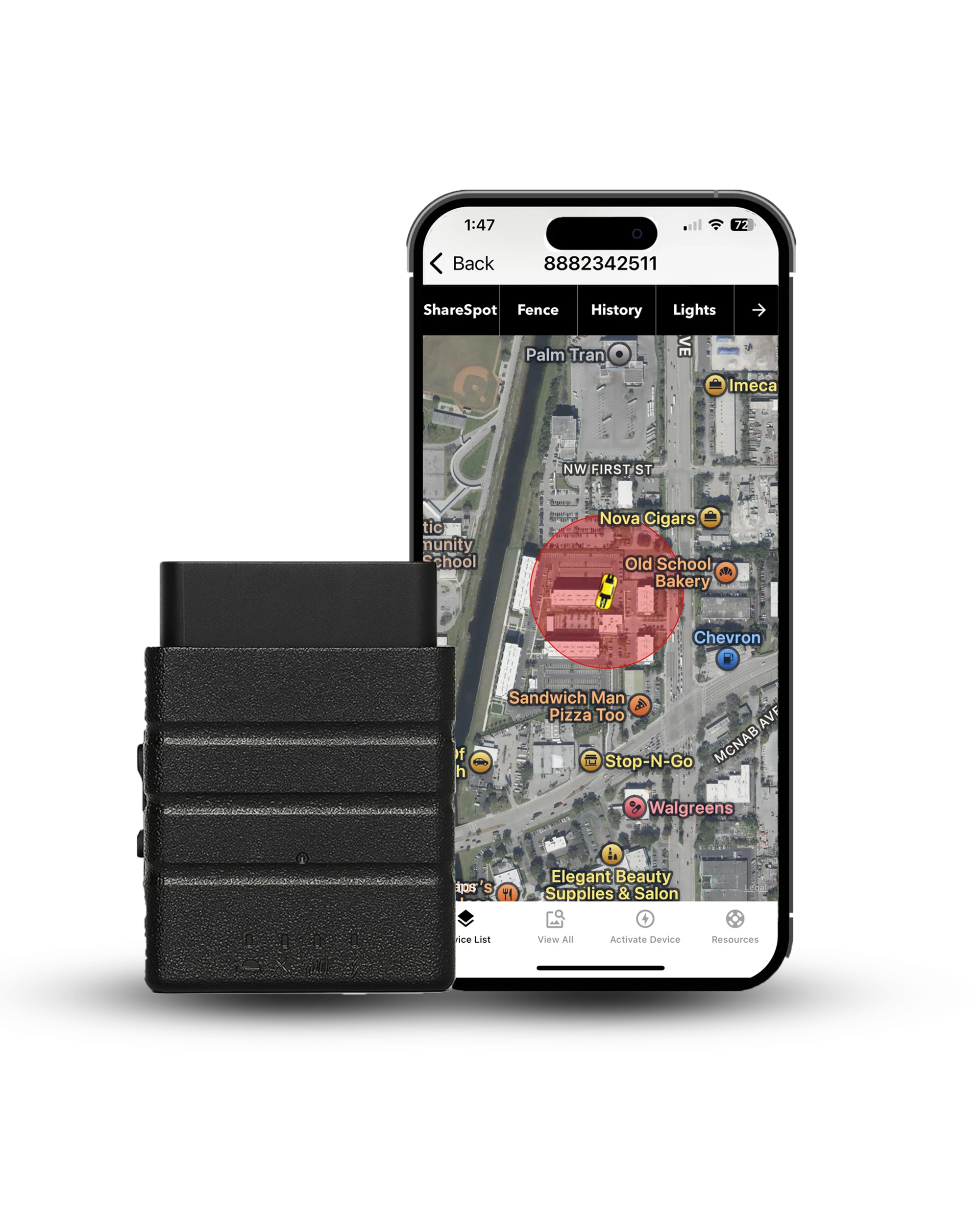
The same technology works on a car, a work van or a teen driver's first vehicle. Konnect plugs into the OBD2 port in seconds and reports live location and speed every 3 seconds. $39.95 for the device with an $8.95 unlimited plan, or $199 once with no monthly fee, and a lifetime manufacturer's warranty either way.
See the Konnect OBD2 TrackerFrequently Asked Questions
Are you concerned about the safety of GPS dog trackers? In the UK, these devices are a popular choice for pet owners wanting to keep their dogs safe. They track your dog’s location, potentially saving their life if they get lost. But, have you ever wondered if these trackers could harm your pet?
As a dog owner, ensuring your pet’s safety is your priority, starting from puppy-proofing your home. To further safeguard your dog, you might consider a GPS tracking collar. These collars provide real-time location updates, offering peace of mind if your dog wanders off. However, they use cellular technology to transmit data. That means your pet tracker is like having a cell phone attached to your dog 24/7. Is this safe? According to the National Library of Medicine, exposure to radiofrequency electromagnetic fields from pet tracking devices should not be a concern for pet owners.
Studies have raised concerns about prolonged cell phone usage, linking it to various health risks. If using a cell phone for an hour is concerning, imagine a device constantly attached to your dog. Currently, there’s no extensive research on the health impacts of GPS collars on pets.
 Buy on Amazon