
Bouncie vs Konnect OBD2 GPS Tracker Comparison & Results
- 01Konnect reports every 3 seconds, Bouncie every 15, and you feel that gap live
- 02Bouncie reads engine codes and driving behavior, which Konnect leaves out
- 03Konnect keeps a full year of trip history, Bouncie keeps 30 days
- 04Konnect costs less both up front and per month across the whole term
- 05Bouncie is continental US only, Konnect covers 150+ countries
Drivers ask about this matchup often, and I understand why. On the surface both plug into your car's OBD2 port and both promise real-time tracking.
I'm Ryan Horban, a GPS tracking expert with more than 15 years of hands-on experience testing vehicle trackers. If you have ever tried to follow a fast-moving car on a map, you already know how much a delay of a few seconds changes the experience. Watching a teen driver, checking a work truck, or reacting to a possible theft, small update delays feel endless.
So when I compared these two, I focused on what you need on the road rather than what the box says. Here is what this comparison covers.


Position every 3 seconds against an industry norm of once a minute, roughly 6 feet of accuracy, and a full year of trip history you can scroll back through.
- 3 second updates
- Roughly 6 ft accuracy
- Geofence and speed alerts
- Tamper alerts
- 1 year trip history
- 150+ countries
Quick Overview of Konnect and Bouncie
Both plug into the OBD2 port, draw power from the car, and send location data to your phone. The difference is how they deliver that data, and how much they ask of the vehicle to get it.
Konnect OBD2 GPS Tracker

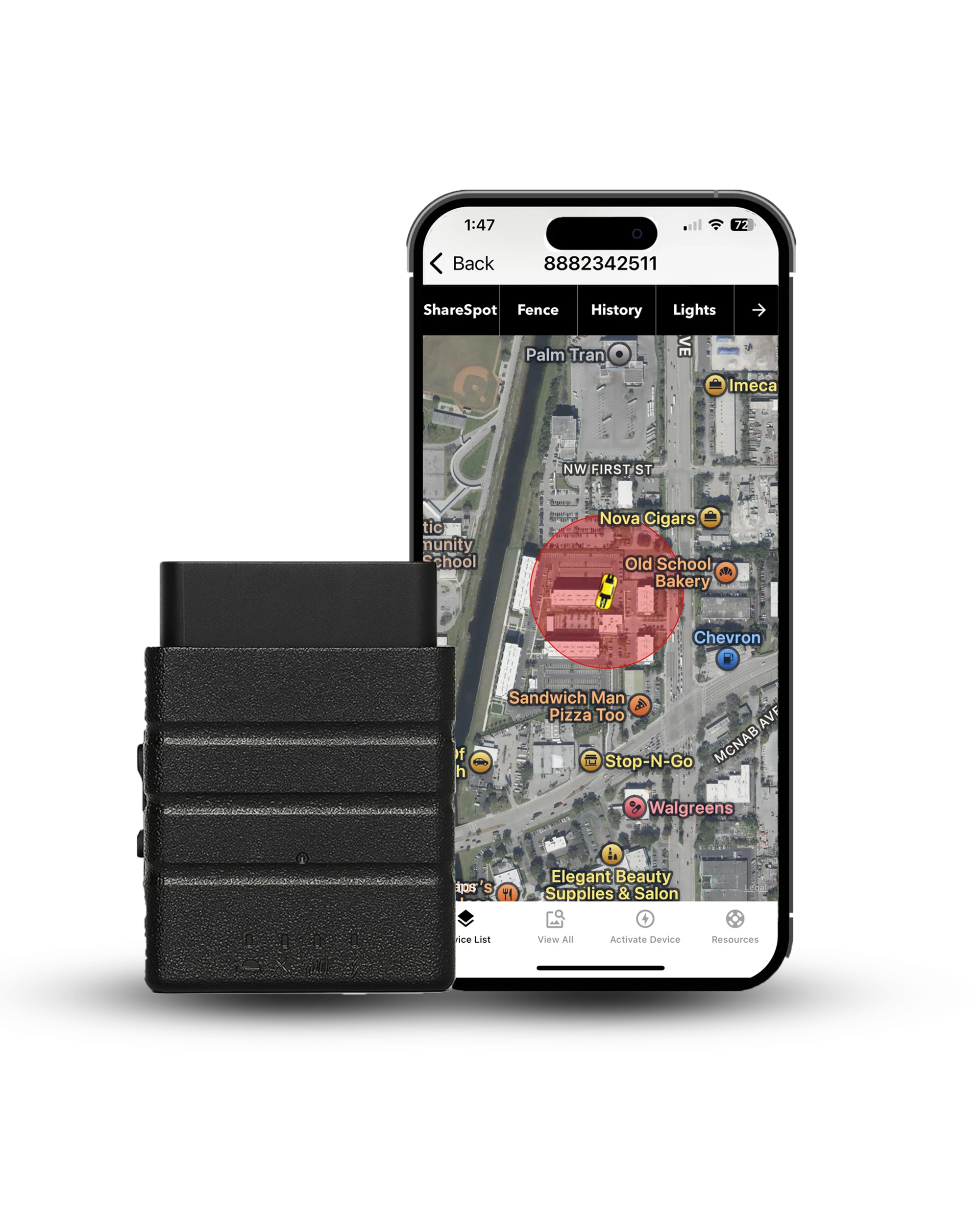
The Konnect OBD2 unit. Plug it in and it is live in seconds.
Konnect is built for drivers who need to know where the vehicle is right now, not sixty seconds ago. Plug it in and it pushes updates every 3 seconds, which makes it one of the fastest consumer OBD2 trackers you can buy.
-
3-second live updates
Position every 3 seconds against the once-a-minute refresh most trackers ship with.
-
Global SIM, 150+ countries
Coverage out of the box without switching networks or adding a roaming plan.
-
Roughly 6 feet of accuracy
Tight enough to tell you which parking bay, not just which street.
-
One full year of trip history
Scroll back twelve months through routes, stops and geofence events.
-
Speed, geofence and tamper alerts
Live alerts as events happen, plus a warning if the device is unplugged.
-
$8.95 a month, no contract
Flat plan, cancel any time, with a lifetime warranty and USA-based support.
Bouncie OBD2 GPS Tracker

The Bouncie unit, built around engine data rather than refresh rate.
If Konnect is built for raw speed, Bouncie leans into driving insight, diagnostics and vehicle health. The device plugs into the same port, but its real strength is how much data it pulls while the vehicle is moving.
-
Engine diagnostics with DTC codes
Reads trouble codes as they appear, with vehicle health summaries and maintenance reminders.
-
Full driver-behavior analytics
Speed bands, braking intensity, acceleration patterns and idle time, logged per trip.
-
Crash detection
Detects an impact and sends an alert, which is a genuine safety feature Konnect does not have.
-
Roadside assistance included
Three free Agero roadside calls a year come with the plan at no extra charge.
-
15-second updates
Refreshes position every 15 seconds while the vehicle is moving.
-
$89.99 device, $9.65 a month
No activation or hidden fees, and the per-device rate drops to $8.35 at three or more units.
How I Tested Both Trackers
Both devices went on the same vehicle, a 2017 Nissan Pathfinder, and ran the same routes on separate trips. Highway merges, quick lane changes, hard stops and tight turns, with a dashcam timestamp to compare against. Then ten days of mixed driving, roughly 45 to 50 miles a day across city, suburban, highway and rural back roads.
-

Every device in this comparison was fitted and driven, not read off a spec sheet.
-

The same test vehicle for both units, so the only variable was the tracker.
How closely the map tracked real movement, how long an alert took to arrive after the event that triggered it, how far back the trip history went and how fast it loaded, and how quickly each device recovered a fix coming out of an underground garage. Where a figure comes from a manufacturer's published spec rather than my own stopwatch, the text says so.
Head-to-Head: Konnect vs Bouncie
| Feature | Konnect OBD2 | Bouncie OBD2 |
|---|---|---|
| Update speed | Every 3 seconds | Every 15 seconds |
| Position accuracy | Roughly 6 ft | Accurate, with a short lag on sharp movements |
| Driving behavior | Speed and movement alerts only | Braking, acceleration, idling, speed bands |
| Engine diagnostics | None, by design | DTC codes and health summaries |
| Trip history | Up to 1 year | 30 days |
| Coverage | 150+ countries | Continental US only |
| Device price | $39.00 on sale, $99.00 regular | $89.99 |
| Monthly plan | $8.95 | $9.65, or $8.35 each at 3+ units |
| Best for | Live tracking, fleets, theft response, teens | Diagnostics, behavior analysis, maintenance |
1. Real-Time Tracking Speed and Accuracy

Konnect kept up with the vehicle almost immediately. With a 3-second refresh, every lane change, sharp turn and slowdown appeared on the map close to in sync with the road. Even during fast merges across several lanes the trace stayed smooth and did not skip or redraw.
Bouncie updated steadily at its published 15-second interval. The full route was tracked accurately and the replay looked good, but quick lane changes and sharp turns landed on the map with a visible delay. Reliable, with more emphasis on consistency than on live movement.
Konnect. Five times more frequent, and it shows the moment the vehicle does something unexpected.
2. Alert Speed and Event Detection

I ran a few controlled stress moments: a hard brake at a light, a burst of acceleration on a merge, and a geofence exit.
Konnect covers the core alerts that matter for live tracking, which are ignition, movement, speed and geofence activity. Alerts landed within a few seconds of the event. Ignition-on arrived shortly after the engine started, speed alerts within a couple of update cycles of crossing the threshold, and geofence exits almost immediately after crossing the boundary.
Bouncie takes a broader approach. Alongside speed and geofence alerts it ties into deeper behavior data, including harsh acceleration, harsh braking and idling. Those were logged accurately and read clearly in the trip reports, but the notifications arrived later than Konnect's, tracking its longer update cycle.
Split. Konnect wins the race on alert speed. Bouncie wins on alert range, because it detects events Konnect does not look for at all.
3. Route History and Trip Detail

Konnect keeps route history straightforward and quick to load. Scrolling through several weeks of drives, the app stayed responsive. Each route carried start and end points, distance, the path travelled and notable events like geofence entries, and the map stayed uncluttered. Retention runs up to one year.
Bouncie goes deeper per trip. Each drive records ignition time, idle duration, braking and acceleration events and total trip time, which is genuinely more useful if you are studying how somebody drives. The limit is how long it stays: Bouncie retains 30 days of trip history, so anything older than a month is gone.
Split, and it depends what you need. Bouncie is richer per trip. Konnect keeps twelve months against Bouncie's thirty days, so if you may need to look back later, that gap decides it.
Want the faster refresh and the longer memory? Konnect reports every 3 seconds, keeps a full year of history, and runs on a flat $8.95 per month with no contract.
Get $10 Off Konnect4. Diagnostics and Vehicle Health

Bouncie is built for people who want to know how a vehicle is being driven and maintained, and it pulls data from the OBD2 system to do it. In testing it read engine trouble codes as they appeared, provided health summaries and maintenance reminders, logged idling, harsh braking and acceleration patterns, and triggered crash detection alerts. For a family watching a new driver, or an operator managing service schedules, that depth is worth paying for.
Konnect does not do any of that, and the omission is deliberate rather than a shortfall. Pulling continuous diagnostic data means a device talking to the engine control unit constantly, on every vehicle, all day. Konnect was designed to stay light on the vehicle's electrical system and put its effort into position reporting instead. For most owners, knowing where the car is and where it has been is the whole job.
That is Konnect's own design rationale for leaving deep polling out. That is not a claim that Bouncie causes problems, and I have not seen any in testing. If you want driving scorecards and engine codes, Bouncie is the device built to give them to you, and this round is theirs.
Bouncie, clearly. Konnect does not compete here and does not try to. If diagnostics are why you are buying, stop reading and buy the Bouncie.
5. Low-Signal Performance
Weak-signal areas show how well a tracker holds a connection, so both units went through underground parking and rural back roads.
Konnect stayed connected slightly deeper into the garage before dropping, and once back under open sky it regained a fix quickly. The 3-second cycle rebuilt the live route almost immediately.
Bouncie lost connection at about the same depth but took longer to rebuild the live view once signal returned. The route replay was fine afterward, but the transition back to live tracking was slower.
Konnect, narrowly. Both handled dead spots. Recovery speed is where the faster cycle pays off again.
6. App Experience

Konnect keeps things light and fast. The home screen loads quickly, switching between vehicles is effortless, and the live map refreshes without hesitation. Nothing feels cluttered and most settings are one or two taps away.
Bouncie leans toward a data-heavy layout, which is the point of the product. During testing the app hesitated at times, mostly when loading longer trip histories or scrubbing through older drives. Nothing serious, but playback felt slower than expected.
Konnect, though this is the most subjective round on the page. Bouncie's app is carrying more, which is part of why it is slower.
7. Pricing and Long-Term Value

Konnect is $39.00 on sale, down from $99.00, with a flat $8.95 monthly plan and no contract. There is also a separate no-monthly-fee model at $199.00, a single payment with no subscription.
Bouncie is $89.99 for the device with a $9.65 monthly plan, no activation and no hidden fees, and the per-device rate drops to $8.35 once you run three or more.
Year one: Konnect $39.00 plus twelve months at $8.95 comes to $146.40. Bouncie $89.99 plus twelve months at $9.65 comes to $205.79. Two years: Konnect $253.80, Bouncie $321.59. Konnect is cheaper at checkout and cheaper every month, so the gap widens rather than closes. At three or more vehicles Bouncie's $8.35 rate narrows the monthly difference, but the device price keeps Konnect ahead.
Konnect. Lower on both halves of the cost, which is unusual in this category and worth stating plainly.
8. Support and Coverage

To compare support, I contacted both companies with the same problem: an activation issue where the app would not recognize the device. Same question, same day, and I watched response time, clarity, and whether I actually got a fix.
Konnect. I called the support line on a weekday afternoon and reached a person in about a minute. They walked through activation, asked for the device serial, and verified it on their end within a few minutes. The useful part was practical: a tip about force-refreshing the app during first-time pairing, and an offer to stay on the line while I reconnected the device to confirm it was reporting. A recap email followed within five minutes. The device also carries a lifetime hardware warranty.
Bouncie. I submitted the same issue through their chat. The greeting came quickly and the replies were polite, but more structured. After a short back-and-forth I was routed to email for account-specific review, which added time to what should have been a quick fix. The emailed checklist was partly generic, but it worked.
Coverage belongs here too, and it is the sharper difference. Konnect ships with a global SIM covering 150+ countries. Bouncie operates on continental US networks with no international roaming, so a cross-border trip into Canada or Mexico is outside what it supports.
Konnect. A phone line beats a chat queue, and the coverage gap is decisive if you ever cross a border.
These two are not really competing. One is a location device that reports fast and remembers for a year. The other is a diagnostics device that happens to know where the car is. Buy the one that matches the question you keep asking.
Which Tracker Fits Your Needs?
Eight rounds. Konnect takes speed, recovery, cost and coverage. Bouncie takes diagnostics outright, and splits alerts and history. The decision is really about which question you are asking of the device.
Choose Konnect GPS if
You mostly want to know where the vehicle is, quickly, and to be able to check where it was months later.
- You want true live tracking with 3-second updates
- You need trip history that reaches back further than a month
- Speed, movement and geofence alerts cover what you watch for
- You want the lower cost both up front and per month
- You drive outside the continental US, or want USA-based phone support
Choose Bouncie GPS if
You want to know how the vehicle is being driven and what its engine is telling you, not just where it is.
- You want engine trouble codes and vehicle health summaries
- Braking, acceleration and idling data is the point of the purchase
- Crash detection matters to you, which Konnect does not offer
- Maintenance reminders and roadside assistance are useful additions
- You drive within the continental US and 30 days of history is enough
Final Verdict
If your priority is true real-time tracking, Konnect is the stronger pick. The 3-second updates, faster fix recovery, twelve-month history and lower running cost make it the more reliable option when you need live visibility without lag.
Bouncie earns its place on depth. Engine codes, driving behavior analytics, crash detection and maintenance reminders are all things Konnect does not do, and if any of those is the reason you are shopping, Bouncie is the device to buy.
Both perform well. The honest summary is that they are built to answer different questions, and the right one is whichever question you keep finding yourself asking.
Konnect OBD2 reports every 3 seconds, 20x the once-a-minute industry norm, keeps a full year of trip history, works across 150+ countries, and carries a lifetime warranty with USA-based support.
Konnect is our own product, so the Konnect half of this comparison is an in-house test rather than an independent one. Both devices ran the same routes on the same vehicle, and where a figure comes from a manufacturer's published spec rather than my own measurement, the text says so. Check anything that matters to you against Bouncie's own listing. As an Amazon Associate, Konnect GPS earns from qualifying purchases.
About the Author

 Buy on Amazon